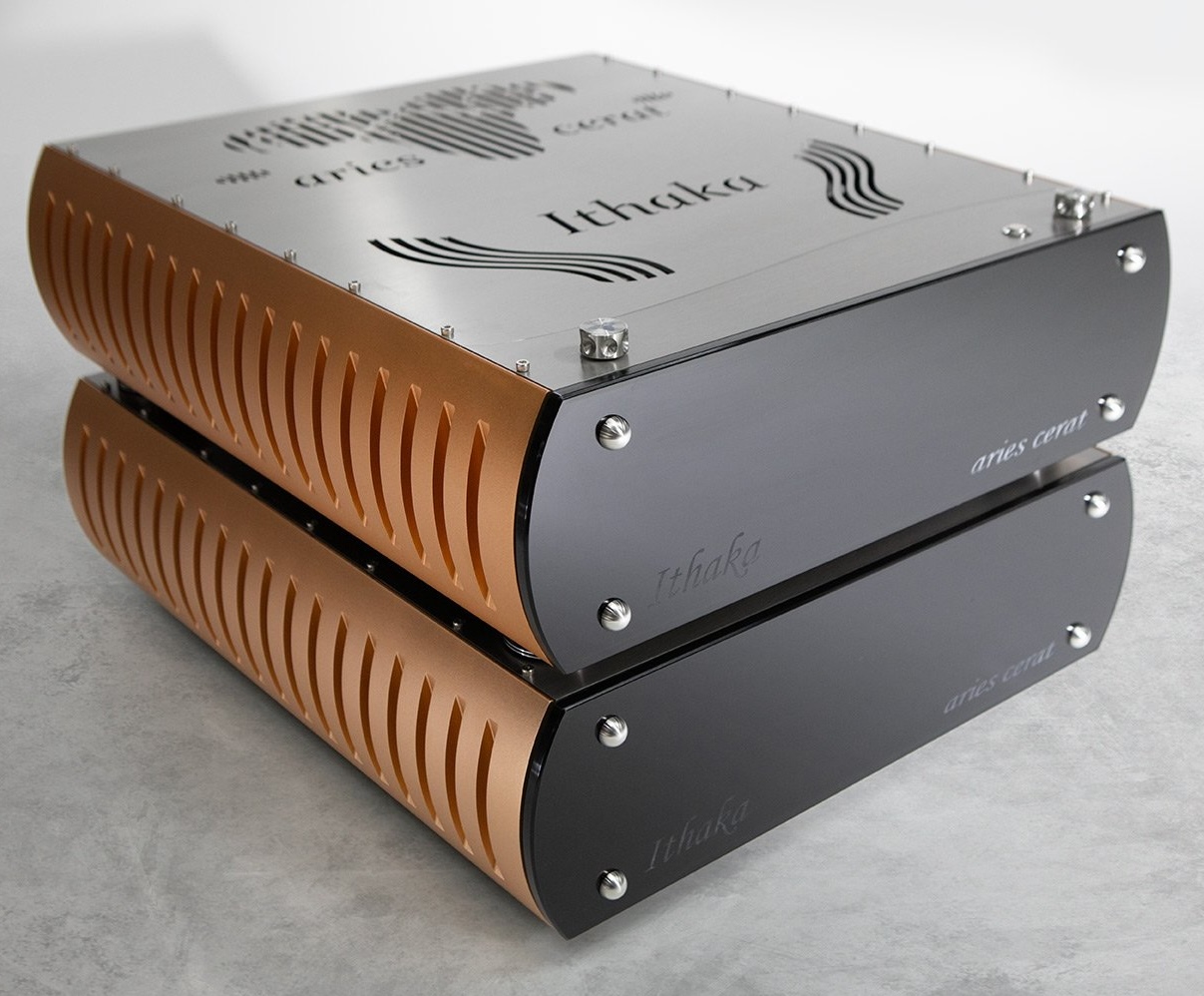
Aries Cerat has maintained a constant presence on Mono and Stereo pages for a long time, reflecting a strong commitment to original thinking and a drive to push boundaries, along with Danos’ curiosity to explore uncharted territories in audio, consistently resulting in new and interesting products.
Exotic and esoteric endeavors and explorations can lead to various conclusions, concepts, and products, but this is not always a perfect solution for achieving viable results.
Creating something meaningful and impactful requires more than dedication. It demands inner vision, a passionate heart, and a broad understanding by the designer of both the technology and its practical implementation, resulting in electronics that not only handle signal transport but also embody the essence of music.
This is where this ultra-high-end boutique manufacturer from Cyprus differs significantly from many other audio manufacturers, with its unique consistency in delivering upper-echelon products that resonate with music lovers and aficionados. From the beginning, Aries Cerat has been a very different kind of audio manufacturer, and the Ianus Ithaka not only stays true to this ethos but also builds upon it considerably.
IANUS ITHAKA
The Ithaka is built around a true ladder DAC architecture. Essentially, a ladder DAC uses a precisely matched resistor network switched according to bit depth, operating in a passive manner without altering or reshaping the incoming data stream.
Equally important is what the Ithaka omits. There are no digital filters in the signal path and none of the sonic characteristics often associated with conventional Delta-Sigma or Multibit designs. The approach is direct, uncompromising, and focused entirely on preserving the integrity of the original signal.
For the Ithaka, Stavros Danos selected the renowned Analog Devices AD1865N-K R2R chip, long regarded by many enthusiasts and designers as one of the finest-sounding converter ICs ever produced. Ianus Ithaka uses 24 of these converters per channel. The AD1865N-K features exceptionally straightforward data handling, free from additional internal processing or manipulation of the incoming signal, allowing the converter stage to operate with remarkable purity and precision.
The incoming data is latched directly to the resistor network without unnecessary intermediary processing stages or complex logic structures. This gives the DAC complete control over the conversion process. The Aries Cerat proprietary Super Clock circuit directly re-clocks and drives the refresh signal, minimizing jitter at the most critical stage of conversion.
The extensive parallel implementation of 24 R2R converters per channel is not merely an engineering statement. Running multiple resistor ladders in parallel dramatically reduces resistor deviation errors, improves linearity, lowers noise, and extends both dynamic range and channel separation. More importantly, the sonic result is immediately apparent. The Ithaka delivers music with greater authority, tonal density, spatial precision, and a sense of ease that places it among the most ambitious digital designs available today.
JITTER
The Ithaka features a comprehensive range of passive and active measures designed to reduce and eliminate jitter at every critical stage of the conversion process. Issues such as signal reflections, overshoot, and slow rise times – common contributors to timing errors – are addressed with dedicated driver circuits and precisely tuned digital line terminations throughout the digital domain.
Special attention has been given to power supply isolation. More than 70 LC filtering stages, using RF chokes and high-speed capacitors, decouple the digital circuitry and converter ICs from the power rails. This method is highly effective in suppressing power-supply-induced jitter, one of the most complex and often underestimated challenges in digital audio design.
Jitter from USB, S/PDIF, and Toslink sources is addressed directly at the converter refresh signal, where timing precision is most critical. Because the AD1865N-K operates without complex internal data processing or multi-stage logic structures, the conversion remains exceptionally direct and time-accurate. Aries Cerat’s approach prioritizes preserving signal integrity through simplicity rather than relying on corrective post-processing techniques.
The proprietary Super Clock architecture extends beyond the converter stage. It also re-clocks both the XMOS asynchronous USB controller and the S/PDIF receiver upstream, creating a unified timing reference throughout the digital chain. As a result, the Ithaka does not require an external word clock input, as its internal clock architecture provides all necessary synchronization with exceptional precision.
I/V STAGE
The R2R converter ICs used in the Ithaka are current-output devices with extremely high impedance, operating very close to ideal current sources. To properly drive the next stage, this current signal must be converted into voltage – a process that plays a decisive role in the final sonic result.
Instead of using conventional op-amp-based I/V conversion or the much simpler resistor method, Aries Cerat developed a dedicated transformer solution for this purpose. The transformer converts the differential current output into a single-ended voltage signal with exceptional linearity and minimal impact on the signal path.
This approach is central to Ithaka’s sonic character. Beyond its technical advantages, the transformer-based I/V stage preserves tonal integrity, dynamic expression, and harmonic structure in a way that conventional alternatives rarely match. Compared directly with more common I/V methods, the result is notably more natural, fluid, and musically convincing.
GAIN STAGE
The true centerpiece of the Ithaka is its output stage. Aries Cerat built it around the latest generation of the company’s TriodeFet technology – the same implementation reserved for the flagship QuintEssence single-ended amplifier.
The circuit is a pure single-stage, single-ended design, executed with exceptionally wide bandwidth and remarkable linearity. This allows the intrinsic qualities of the digital conversion stage to emerge without restraint, preserving tonal density, harmonic complexity, and dynamic nuance with uncommon ease.
Its specifications alone hint at the capability of the design. With an output impedance of just 1 ohm and the ability to deliver up to 12 watts directly into a loudspeaker load, the output stage has the drive and authority of a compact power amplifier. That capability was never intended as a practical feature for everyday use, but rather as evidence of the stage’s extraordinary stability and current delivery.
During development, the Ithaka was often used to drive loudspeakers directly. This unconventional approach allowed Aries Cerat to refine the circuit by listening directly to the output stage, shaping and evolving the final voicing of the converter with a level of immediacy rarely encountered in digital design.
THE POWER SUPPLY
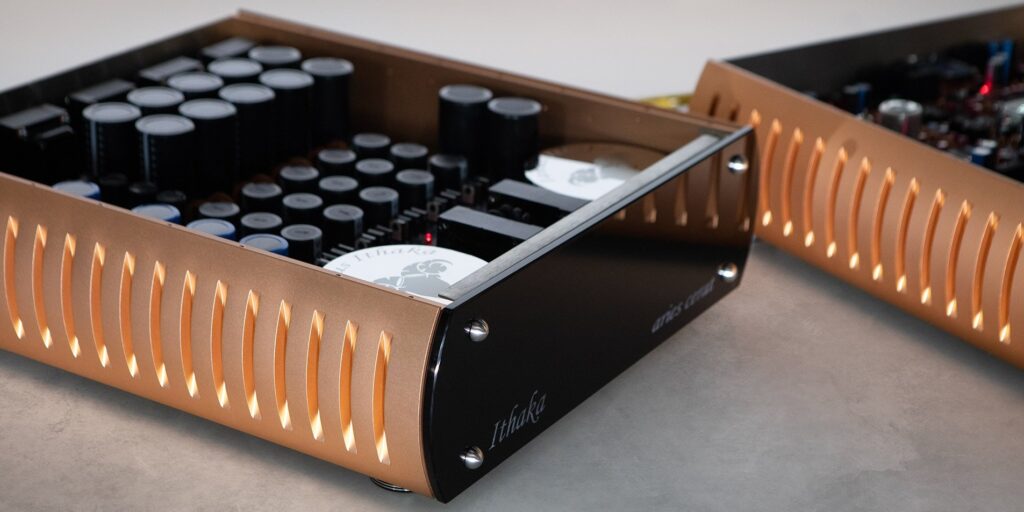
The Ithaka is powered by a substantial external power supply unit, designed with the same uncompromising attention to detail that defines the converter itself. Every critical section – digital, analog, TriodeFet, and bias circuitry – receives power from independently regulated, ultra-low-impedance supply stages that use complex multi-stage passive filtering networks.
Aries Cerat places enormous emphasis on power integrity, which is evident throughout the design. A carefully selected combination of premium inductors and capacitors suppresses both low- and high-frequency noise, creating exceptionally quiet power rails and an unusually stable operating environment for the sensitive conversion circuitry.
Particular attention has been given to the TriodeFet output stage, which is supplied by a high-energy, high-current power supply with a triple-choke filtered topology. The result is a sense of effortlessness and composure that extends from microdynamic subtlety to full-scale musical swings.
Power delivery for the entire DAC is managed by two low-noise 500 VA transformers working with discrete Schottky SiC rectifiers. Beyond their technical advantages, these choices contribute directly to Ithaka’s unmistakable sense of authority, tonal saturation, and ease during demanding musical passages.
THE MUSIC
An extensive music program was used during the evaluation of the Aries Cerat Ianus Ithaka DAC. Here are several carefully hand-picked albums that showcase the expressiveness and soundnesses of this top-tier DAC.
Regardless of the music genre, the Ithaka accurately and vibrantly reflected the music’s dramatic structure and all its shifts, repeatedly providing ultimate insight without requiring specific articulation.
CURT CRESS — AVANTI
Avanti is a very interesting recording from Curtis Cress, known artistically as Curt Cress, who has contributed to more than 12,000 records and played on some of the most iconic recordings as a session drummer.
It is quite an interesting instrumental recording that stands out in the era in which it was recorded. Most importantly, it sounds remarkable and can be played very loud without falling apart, thanks to subtle mastering compression. Unlike the overused compression common today, it was applied mildly on this album, along with very well-captured instruments.
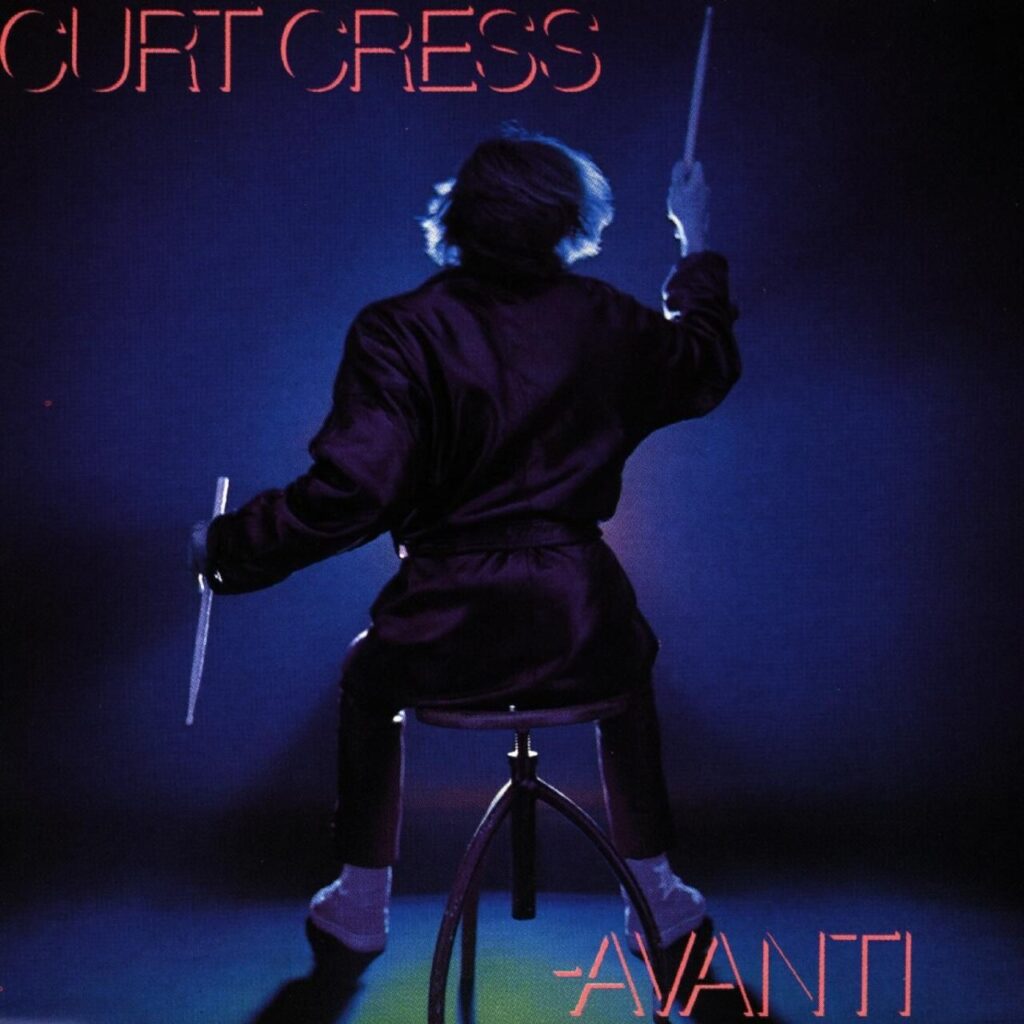
With Ianus Ithaka, the already great-sounding tracks become even more lively, with a majestic punch and an in-your-face impact that this record demands.
Ithaka easily and instantly follows the tempo and responds with a mighty, snappy heart to the drum hits, without rounding the leading edges of the percussion or pushing the dynamism into the background, as some DACs – regardless of price – can do too easily, demonstrating that when digital signal transcoding is executed properly, especially after initial decoding and with properly depicted gain stages, the music can have an instant, tremendous impact that engages both the brain and the senses to experience the material fully.
NATHAN RIKI THOMSON — SHAPED BY THE SEA
Shaped by the Sea fits perfectly into the narrative of evaluating the sheer potency of any system component, and it is especially relevant to assess the front end, particularly the track “Gaia (Kasper’s Theme).”
There is always a complicated and daunting task to ensure that the dynamic and harmonic nature of the music is preserved and reflected in the best possible way. This is where mediocre DACs and top-tier DACs differ – a matter of technical approach, understanding of digital-to-analog conversion, and making all connected electronics, parts, and circuits work in sync to present an objective and believable reproduction.
Ianus Ithaka points directly and straightforwardly to the core of the music, reflecting the vibrancy and immediacy needed to create a sonic illusion and ignite the necessary interactive response from the listener.
If this does not happen, then no matter how many boxes, esoteric materials, complicated circuits, or groundbreaking ideas are involved, if the music cannot be reproduced as a harmonic whole, the basic principles and what seem like simple endeavors become the most complicated tasks.
Ianus Ithaka demonstrates that it is a mature product with all the bells and whistles that give it a designated high-end audio DAC status. Yet, this is only a fundamental structure upon which everything else must be built, in a way that does not drain the life and dynamism from the music. Aries Cerat’s top-tier DAC operates around the very essence of what is required, but it goes beyond, with its extraordinary ability to reveal deeper layers of density, allowing for full dynamic expansion while preserving the subtlety and intricacies that make music so spatially potent and emotionally engaging.
Cementing its value repeatedly across many different tracks and albums, Ianus Ithaka, through Shaped by the Sea, reassures that there are no shortcuts to making music palpable and lively. The result is far more than the sum of its parts – a unified fusion of deliberate know-how, precise direction, and a deep understanding of music’s core values and how they can be combined.
All of this makes Ianus Ithaka a true standout among digital-to-analog converters, regardless of price.
RON CARTER — IN NEW YORK
There are numerous recordings by Ron Carter that I greatly enjoy. However, this particular album is in constant rotation in both my reference and personal favorites folders, and I play it repeatedly. There is an instant, magical interplay between double bass and guitar that, while it may appear purely minimalistic, is actually a lyrical masterpiece that radiates and vibrates with a unique magnetic quality.
Magnetism is indeed one of the standout virtues of the Ithaka DAC. The difference between a good and an average DAC, or a well-sounding and a great-sounding DAC, or even a standout and a magnificent DAC, always lies in its ability to provide that glue factor – not by fixing anything sonically or being overwhelmingly proactive, but by holding the listener in their seat with its impact.
The Ithaka shares the renowned Aries Cerat organic clarity, but as becomes instantly evident with this album, it offers greater intimacy, more subtle detail, increased interaction between the two players, and broader sonic latitude and emotional range, allowing the instruments and performers to achieve a truly guileless presence.

This is something that many DACs, regardless of price, lack, and it becomes quickly evident with the In New York record: the sheer weight of the instruments’ notes translates to an objective projection of the instruments’ physicality and, most importantly, the reproduction of properly structured timbre, tone, and color.
This is affected by the DAC’s ability to deliver the required density, as well as the necessary decay and delay, which are crucial for forming acoustic nodes and reflecting timing data. These factors are closely linked to the vibration tails, note speed, and timing, all of which – along with accurate phase decoding – are essential for creating and reproducing the acoustic depth of the sonic sphere.
The Aries Cerat Ianus Ithaka excels at this, letting the double bass and guitar notes expand freely, both horizontally and vertically, into the room – never attaching to the speaker drivers, but escaping entrapment and freely materializing in the listening environment.
The Aries Cerat Ianus Ithaka excels at this, allowing the double bass and guitar notes to expand freely, both horizontally and vertically, into the room – never attaching to the speaker drivers, but escaping confinement and materializing naturally in the listening environment.
Too many products today are rushed to meet market demand. Despite Aries Cerat’s large and growing portfolio, Stavros Danos still takes time to explore new approaches, but never for novelty’s sake: if something works, it is implemented; if not, it is left behind. This is the only proper attitude when dealing with something as fragile as musical information and musical effusive energy.
CONCLUSION
I have followed the brand from the very beginning and have had the opportunity to explore many products from their impressive portfolio, as well as review several of their components over the years. The Ianus Ithaka continues the heritage and legacy of Aries Cerat, but as expected from Danos, it also introduces something refreshingly unique.
Every Aries Cerat DAC and product I have tried so far has this unmatched, unrestrained sense of authority and an enormous ability to shift from the quietest musical passages to thunderous crescendos with lightning speed.
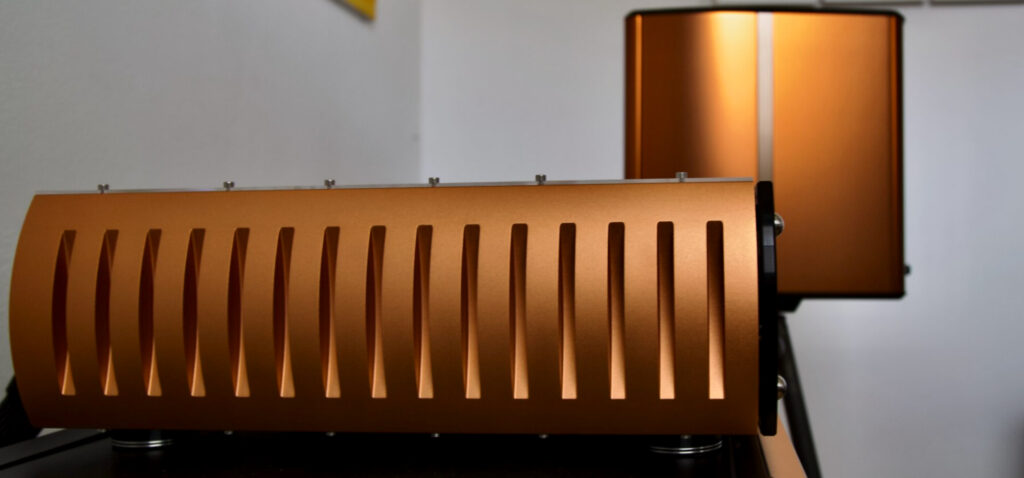
The power and delicacy come from the mighty heart, TriodeFet technology, as well as numerous refinements and further developments of already proven approaches.
The Ianus Ithaka DAC follows well-established paths, but adds more vigor, unreserved power, and a heartfelt, essential musical aura, intimately connected with the essence of the music.
One must be in tune and in sync with the music to fully comprehend how to mimic, reflect, and transcribe the original musical message without hindering, altering, or turning it into something artificial. Stavros Danos’s eclectic love for music is evident with each new and different track or album played. Regardless of genre, this flagship DAC responds to the musical drama, dynamic shifts, subtleties, and nuances of any program. Most importantly, it delivers that rare interactive quality for which Aries Cerat is known, a quality that is not easily achieved.
The art of digital-to-analog decoding goes far beyond simply deciphering zeros and ones; it involves understanding gain staging, designing appropriate power supplies, and selecting matching electronic components that create a sonic harmonicity, an environment where music can reveal itself fluently and without constraints.
This is precisely the leitmotif of Ithaka, evident in every note played. The Limited Edition series top-tier Aries Cerat DAC cuts through the music with a unique combination of buttery softness and razor-sharp impact that leaves the listener deeply moved – but not in the exaggerated way often found in even some of the more expensive DACs. Ianus Ithaka establishes its magnetic pace from the start and maintains its powerful output with unique consistency and without fatigue.
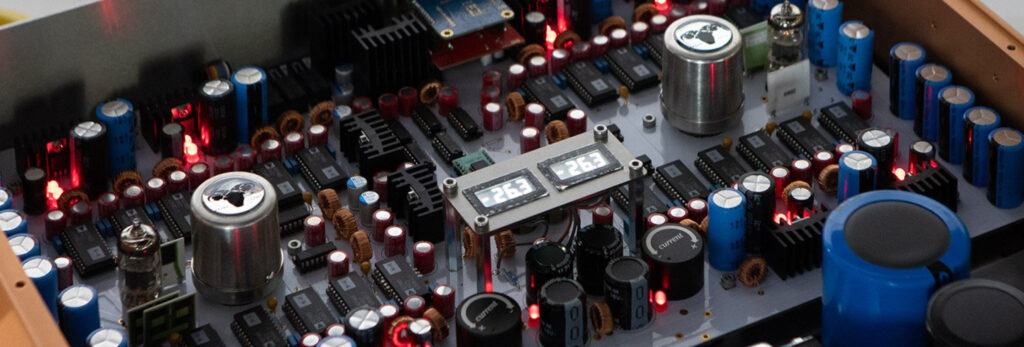
As with all of Stavros Danos’s creations, the Aries Cerat Ianus Ithaka DAC sets a high standard that is difficult to match. Its chameleon-like nature adapts on demand without interfering, never imposing its own imprint or sonic signature, and always engaging the listener. It skillfully bypasses sensory defenses, strikes directly at the core of the senses, and delivers a powerful emotional impact with a unique vibrancy that resonates deeply with the music and fosters an unprecedented interaction between the music and the listener.
Stavros Danos’s laser-focused determination and out-of-the-box exploration of sonic extremes does not skip the Ianus Ithaka, making the DAC from the Limited Edition series one of the most vibrant, powerful, and tonally colorful DACs I have tried so far.
For its design, forward thinking, and musicality, I am pleased to grant the Aries Cerat Ianus Ithaka DAC the 2026 Modern Stereo Upper Echelon Product Award. •
PRICE
European RRP € 82.000,00
TECHNICAL
DIGITAL SECTION | |
| IC Chip Array: | 24 R2R converters per channel, complimentary current output using the top grade Analogue Devices AD1865N-K with 12 converters per bank, 24 per channel, 48 in total |
| Current to Voltage Conversion: | Transformer I/V conversion with custom wideband transformers, balanced current to single ended voltage conversion. |
| Additional Clock: | Internal Super-Clock by-passable on the fly, triple regulated supply, quad-stage pre-filters |
| Regulators: | Eight discrete ultra-low-noise regulators for the 4 converter banks,quad-stage pre-filters |
| POWER SUPPLY SECTION | |
| PSU: | Massively over engineered power supplies, power input filters |
| PSU filering: | Extensive local decoupling using tuned LC filters |
| Mains Transfomers: | 2 Low noise 500VA torroidal transformers, over 4 Farad total system capacitance, wideband local decoupling |
| Pseudo-battery system: | Four independent Pseudo-battery systems for isolating all analog and digital stages from the power grid, Quad-stage pre-filters |
| TriodeFet PSU: | Triple choke-filtered, veru high current capacitor supplies |
| INPUT & OUTPUT SECTION | |
| Gain Stage: | Third Gen TriodeFet output stage, Single-Stage, Single Ended circuit. 1A idle current Class A operation. |
| Output Range: | RCA: 30Vpp output @ 0db 10Vrms Balanced output: standard |
| User Selectable Output Tuning: | User can pre-load the output stage using external resistive modules, to fine-tune the sound. |
| Output: | 2 x RCA, 2 x Balanced. True Balanced output standard. Floating RCA output switchable (ground loop resolver). |
| Output Impedance: | 1 ohm (balanced and SE output). Minimum resistive loading to outputs:3ohm. |
| USB input: | Data rates up to 24/384KHz |
| Other inputs: | AES/EBU, S/PDIF, BNC. |
| Jitter attenuation: | Down to femtosec level |
| Dimensions: | 540mm W x 580mm D x 165mm H |
| Weight: | 160kg total unpacked |
CONTACT
ARIES CERAT
Tel: +357 99307099
email: enquiries@aries-cerat.com