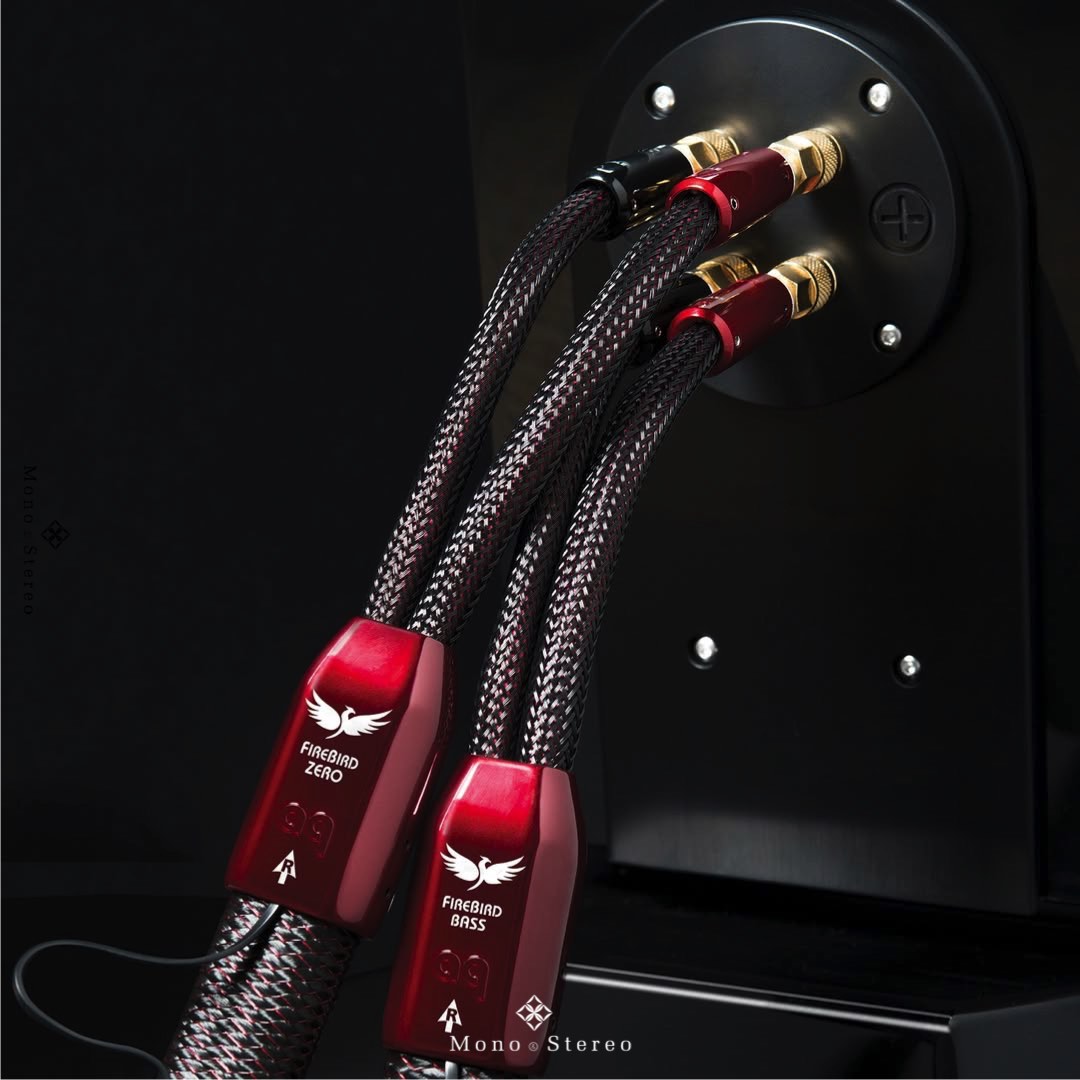
AudioQuest writes: “What do Bowers & Wilkins, JBL, KEF, Klipsch, MBL, Monitor Audio, Paradigm, Perlisten, Sonus faber, Stenheim, Vandersteen, certain models from Audiovector, ELAC, Dali, MartinLogan, Rockport, Tannoy, and the GoldenEar T66 all have in common?

They love to be BiWired by AudioQuest.
Indeed, many performance-oriented speakers feature separate inputs for bass and treble frequencies, enabling the advantages of BiWiring.
BiWiring is an effective way to ensure superior sound for the same or less money!
All BiWiring* takes Bass energy out of the Treble cable — like taking the Bass waves out of the water while the Treble is “swimming.”
BiWiring with AQ’s BASS Speaker Cables featuring RF/ND allows the amplifier to sound better:
AudioQuest’s BASS cables feature AudioQuest’s patented Radio-Frequency/Noise-Dissipation — which reduces distortion by actually pulling RF off the output of the amplifier instead of feeding RF into an amplifier’s circuitry.
The reduction in amplifier circuit-misbehavior, the lower TIM (Transient Intermodulation Distortion), takes the irritation and “tension” out of the sound for that wonderful “ahhh!” that we all crave from good audio, music, and dialog.
Effective BiWiring requires separation between the magnetic fields of the Bass and Treble conductors. This can be accomplished with two separate cables or by BiWiring with a properly designed single cable.”