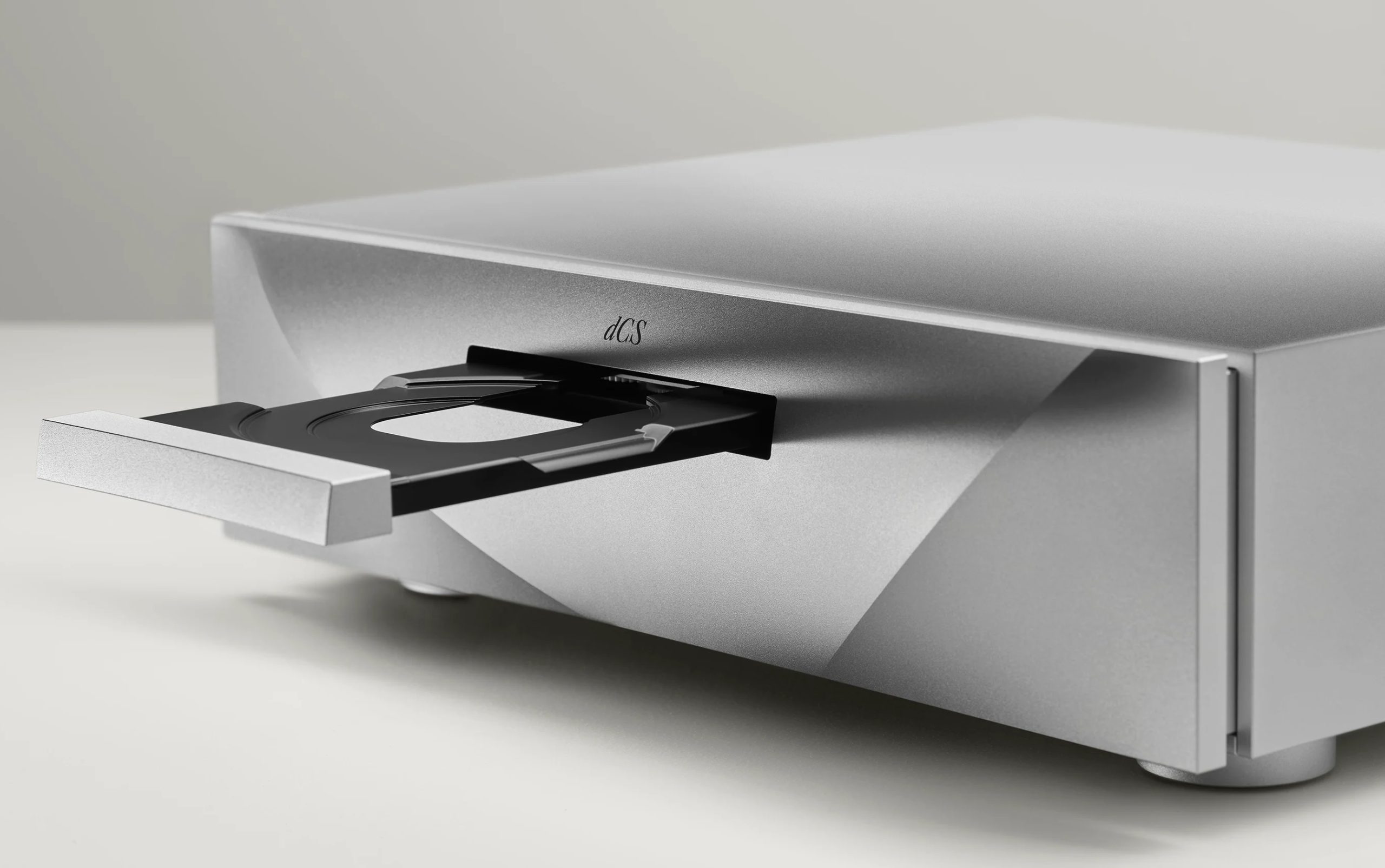
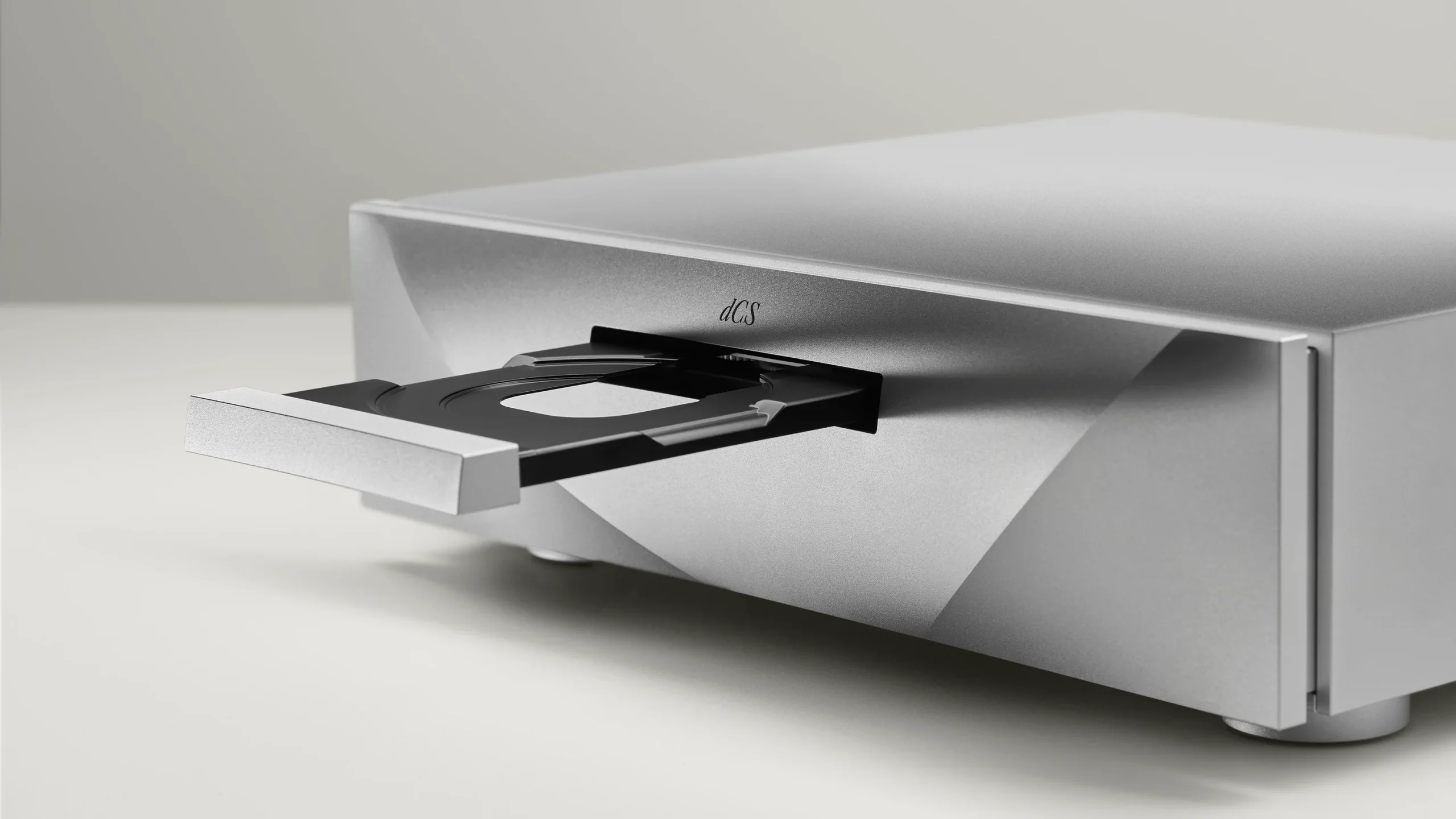
The dCS Varèse Music System launched in 2024 with five components: a Core, Mono DACs, User Interface and Master Clock, plus the Varèse Remote Control. In September this year, we introduced an optional Varèse Transport, available to order through Varèse distributors and retailers. The Transport plays CDs in their native 44.1kS/s format and Super Audio CDs in their native DSD format. It benefits from a bespoke chassis design and utilises the novel dCS ACTUS interface developed for Varèse. These innovations have helped dCS to further reduce noise and vibration and ensure bit perfect transmission of audio signals, allowing listeners to hear even more of the musical, sonic and spatial details contained within their silver discs. It is dCS’s simplest Transport yet to set up and can be controlled via the Varèse User Interface, Varèse Remote Control, or Mosaic ACTUS app, reflecting dCS ambition to improve performance whilst bringing listeners a more intuitive user experience. In this article, dCS provide a look at the Transport’s construction, and the steps taken to enhance performance. Also is discussed the factors that are integral to ensuring great sound when playing discs, and explain how we have improved on existing Transport designs to deliver tangible benefits for listeners…

Design Factors & Performance: Mechanisms
In a digital audio system, the role of a CD/SACD Transport is to extract the data from a disc and output this to a receiver, typically a DAC.
There are several factors that can affect a Transport’s performance. These include the type of mechanism used to read discs, the available inputs and outputs (I/O), and the product’s mechanical design.
The mechanism is the part of a Transport which loads and reads an audio disc, and outputs the data stored on the disc as a continuous stream of digital audio. For optimal performance, a mechanism must have the following properties:
- It must offer bit-perfect reading and output of data
- It must be able to accept an external clock signal
- It should be ‘quiet’ – generating minimal acoustic noise and vibrations during playback
The Varèse Transport, like the Rossini and Vivaldi Mark II Transports, uses a Sound United D&M Mechanism. This mechanism offers bit-perfect reading and output, meaning it is able to read all of the data stored on a disc and output it to the Varèse Transport with no errors or loss of information.
The Sound United D&M mechanism can be locked to an external clock signal. This means we are able to use the high-quality VCXO clock circuitry inside the Varèse Transport to control the mechanism’s operations, as opposed to clock circuitry inside the mechanism itself. This helps to reduce jitter on the audio signal output from the mechanism.
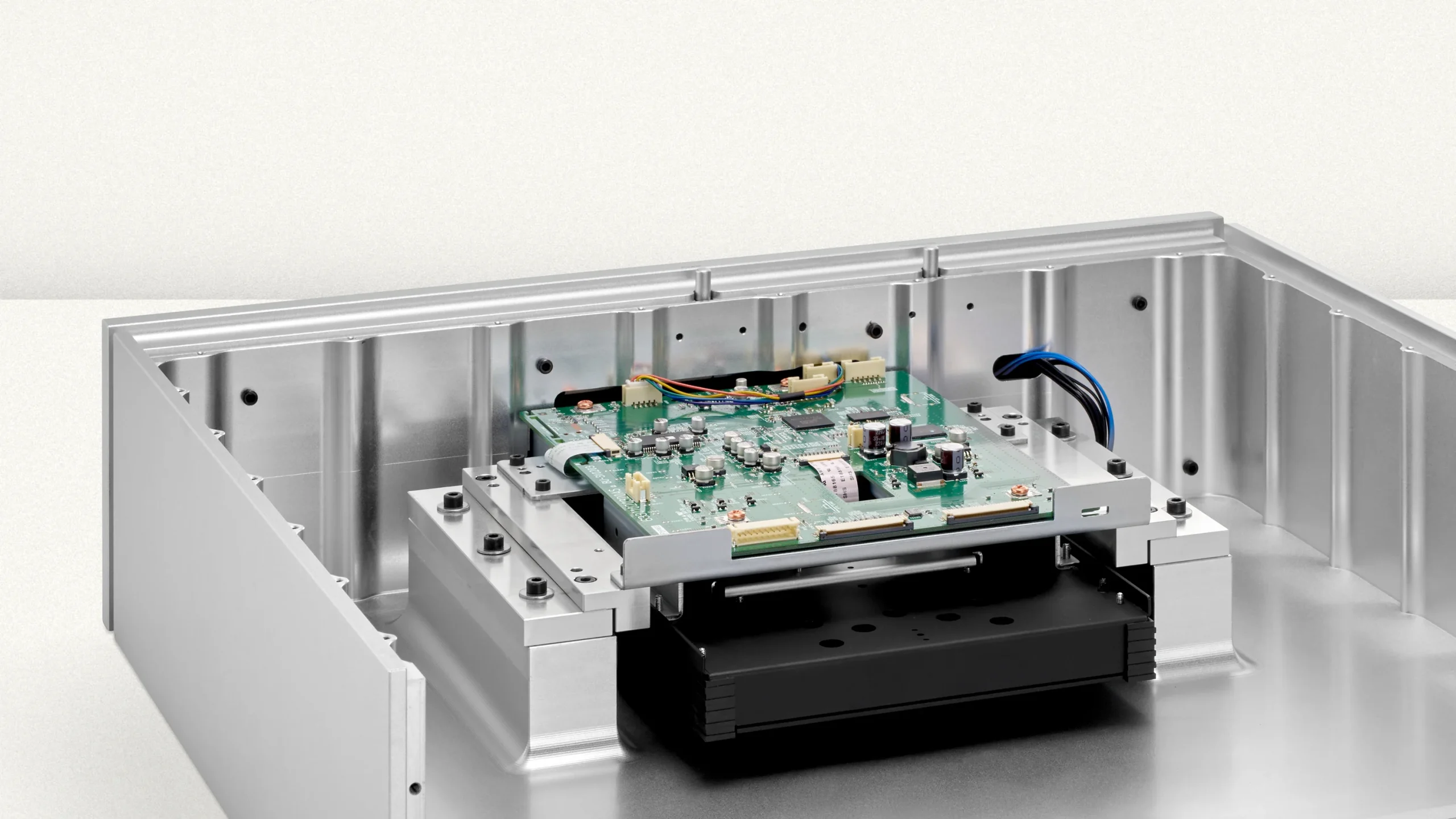
In addition, the mechanism is designed to operate with minimal noise and vibration. This is essential for good performance, as excess vibration when parts are moving (such as when a disc is spinning) can cause a Transport to project acoustic noise into the room, which is not desirable. This can be a particular issue for SACDs, which have to be spun at a faster rate.
The level of vibration and noise that a Transport generates is not dictated by the mechanism’s design, or the choice of mechanism, alone – in fact, what matters most is how the Transport’s chassis is designed, and in particular how the mechanism used is mounted to the chassis – but it is important to select a solid, stable mechanism that will not introduce excess noise or vibration during playback.
The Varèse Transport benefits from both a quiet mechanism (the Sound United D&M), and a novel mounting system. Together these factors have enabled us to reduce noise and vibration, resulting in the quietest, lowest-vibration dCS Transport yet.
Inputs, Outputs & dCS ACTUS
Once the data from a CD has been read, the Transport’s mechanism outputs data as I2S – raw audio suitable for sending between components on a circuit board (I2S is an abbreviation for Inter-IC Sound – ICs being Integrated Circuits, or chipsets).
This audio needs to be encoded to a format that can safely be sent from the Transport to a receiver. The standard method here is to use well-established interfaces such as AES or S/PDIF. This sends the audio data, along with an embedded clock signal, through an interface designed to be run between units on various lengths of cable.
The Rossini Transport, Vivaldi Transport and Vivaldi Transport II all utilise multiple AES connections to a receiver, to allow both native 44.1kS/s data from a CD, DSD from an SACD, and optionally upsampled DSD or high-rate PCM (DXD) from a CD. This requires three AES connections as well as an RS232 cable between the Transport and the DAC. This configuration allows the system to automatically adjust inputs, based on the type of disc being played.
Rossini and Vivaldi systems employ a dedicated clock connection between the Transport and DACs, for optimal sound quality. While AES and S/PDIF have clock information embedded in the signal, recovering it is difficult, and this can present issues such as intersymbol interference, which cannot be solved. Using a dedicated clock connection to synchronise the Transport with the DAC provides better sound quality through lower jitter, as intersymbol interference is no longer an issue when using a wordclock connection.
In total, this means five cables are required to connect a Rossini Transport to a Rossini DAC to achieve all possible functionality and for the best quality: three AES cables, one RS232 cable and one clock cable.
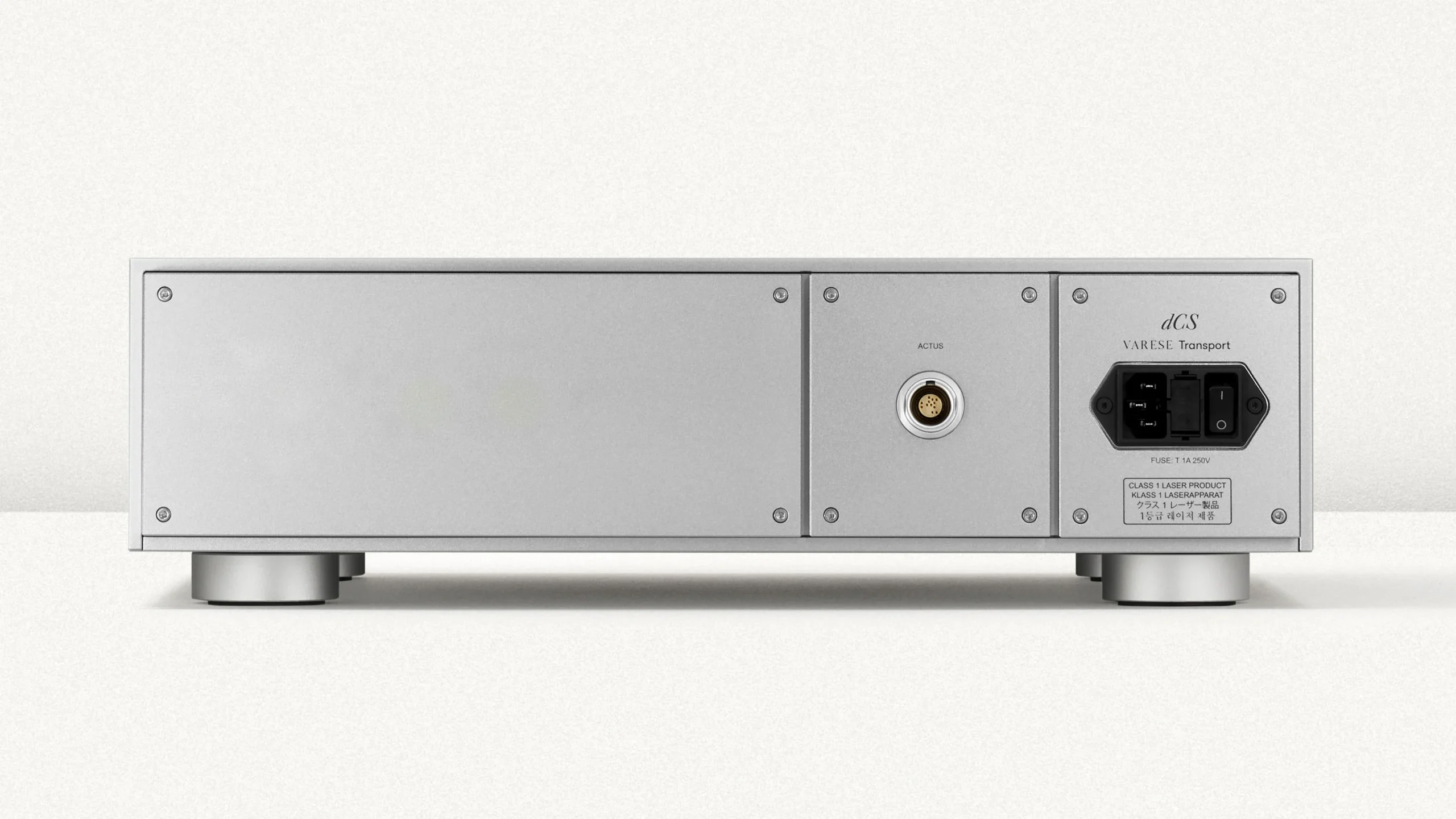
The Varèse Music System benefits from the ACTUS interface – a bespoke interface created by dCS to allow Varèse components to communicate and send necessary signals to the Varèse Core (and vice versa), over a single ACTUS cable running between that unit and the Core.
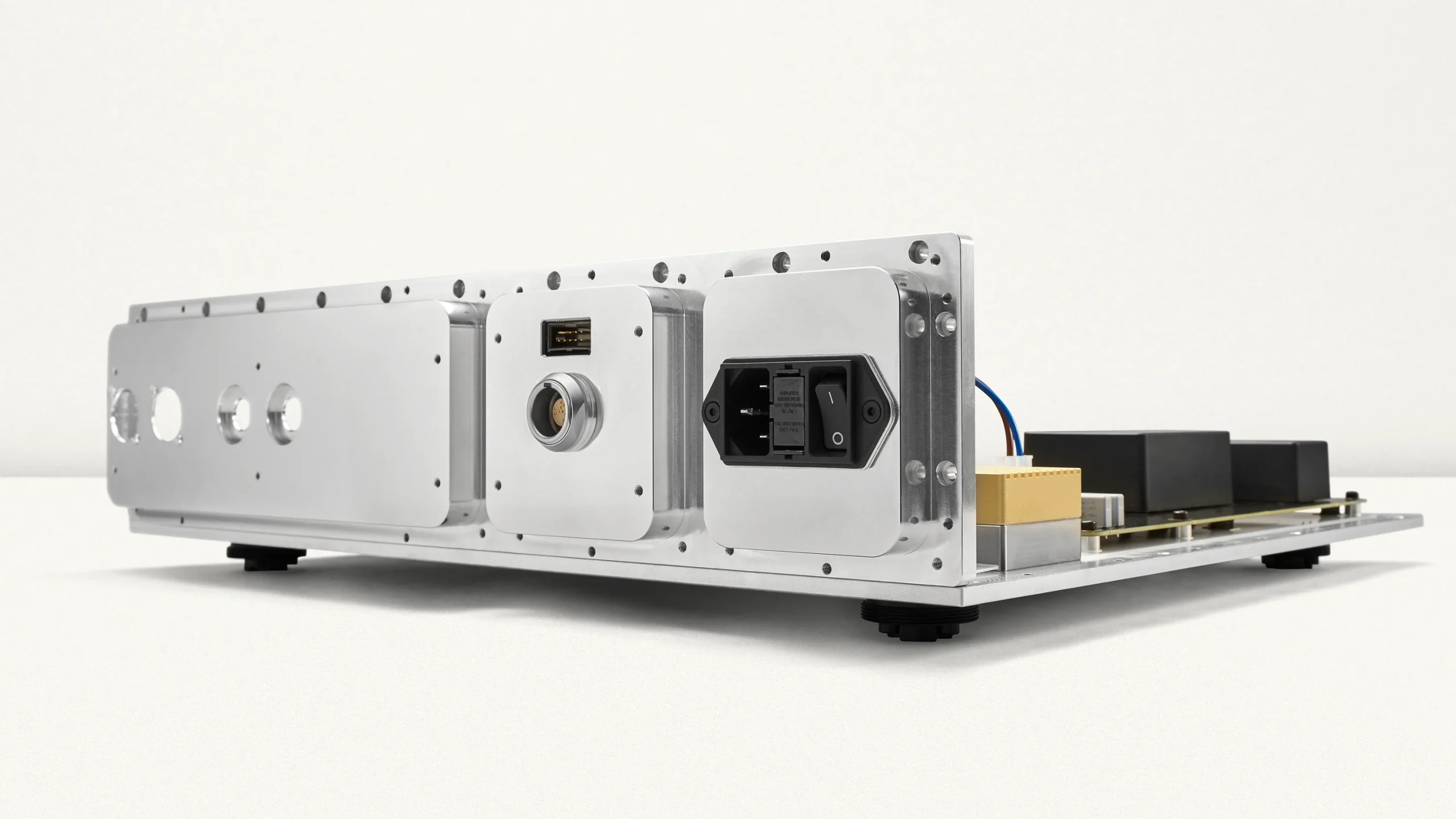
The Varèse Transport utilises a single connection, meaning the only input and output is ACTUS. The ACTUS cable running from the Transport can be connected to any one of the ACTUS ports on the rear of the Varèse Core (with the exception of the dedicated clock input marked Clock). This connection carries:
- Native format audio data
- Control signals
- Tomix clock signals
The Varèse Transport outputs CD and SACD data in its native format. For CD playback, it outputs 44.1kS/s PCM. For SACDs, it outputs DSD. No upsampling or format conversion is carried out in the Transport – if a listener wishes to convert PCM data to DSD, for example, this would be done in the Varèse Core, and not the Transport.
Control signals allow the system to communicate, allowing listeners to play, pause, skip tracks, stop playback, or eject and load discs by selecting commands on the Varèse Remote Control, the User Interface, or the Mosaic ACTUS app.
The Tomix clock signals fed to the Transport via ACTUS allow the Transport to be synchronised with the rest of the Varèse system. The Transport uses a 22.5792MHz VCXO to synchronise the audio output from the mechanism. It also uses a 27MHz VCXO – the mechanism uses a 27MHz clock signal for its internal workings. The speed of the 27MHz VCXO is synchronised to the 22.5792MHz VCXO, which is in turn synchronised to the rest of the Varèse system via the Tomix clock signal. This ensures that the Varèse Transport has minimal levels of intrinsic jitter. It also ensures that factors like heat and vibration can be effectively managed. For more information on how these factors can cause jitter, and why jitter needs to be properly managed in an audio playback system, see our whitepaper, dCS Clocking – Explained.
Using ACTUS to connect the Varèse Transport to a Varèse Music System simplifies cabling from an equivalent five cables down to one. ACTUS drives audio performance higher than standalone AES or S/PDIF connections through an integrated Tomix clock signal for reduced jitter, guarantees bit perfect audio, and allows for the disc playback on the Transport to be seamlessly controlled from a variety of touchpoints.
Chassis Design: Reducing Noise & Vibration
The Varèse Transport features our most advanced Transport chassis design yet, with the dCS engineering team developing a new mounting mechanism, and a new chassis construction.
In existing dCS Transports, the disc mechanism is mounted on a sub-chassis constructed from sound dampened aluminium, which is secured to the chassis base plate with standoffs. The chassis is constructed from six individual aluminium plates, milled from billet aluminium, which are secured with concealed fixings.
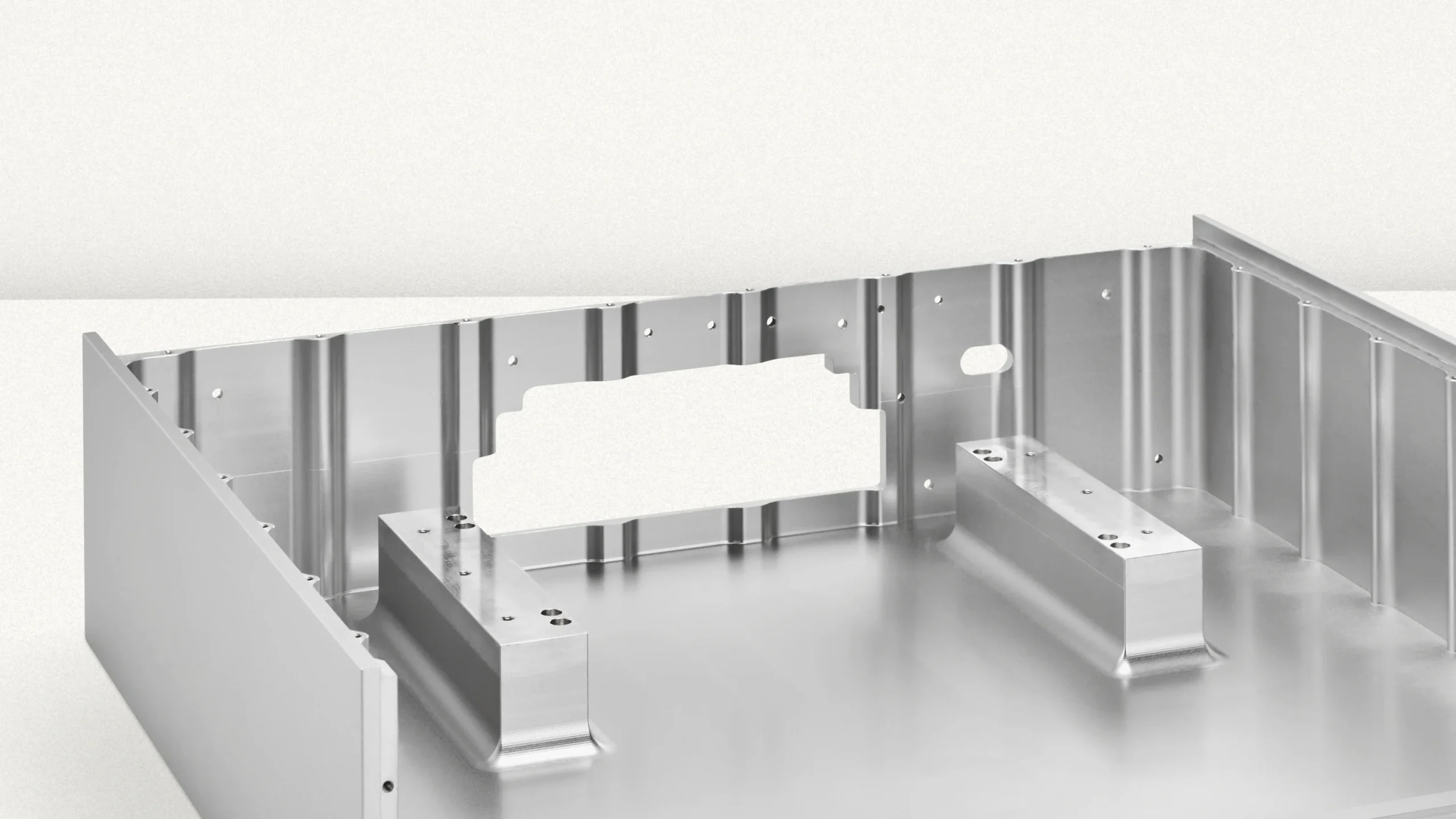
The Varèse Transport, in contrast, is constructed from two main parts. The first forms the Transport’s top, front and side panels, and holds the CD mechanism. There are no joins between panels – instead, this piece is made from a single, continuous, unbroken billet of aluminium. The second part – also milled from a single piece of billet aluminium – forms the base and rear panel, which holds the Transport’s electronics. Dress plates are secured to the front, rear and base plates, for a cleaner look, and the Transport’s fascia features the same distinctive styling seen across the Varèse range.
The screw holes for all fixings are machined as a part of the milling process for the chassis, which means extremely fine tolerances can be used, and no self-tapping screws are required.
The screw holes are positioned such that they will not allow key frequencies of electromagnetic radiation to escape from the product. It is effectively an electrically sealed unit, with no interference able to get in or out. This approach to electromagnetic performance spans right through to the types of screws used on the Transport, which are a custom specification, manufactured to meet the demands of the Varèse system. Having an electrically sealed environment for the Transport helps to ensure consistently high performance, whatever environment the Transport is used in.
The Varèse Transport also benefits from a new mechanism mounting system. During the engineering process, we trialled various methods of mounting the disc mechanism to the chassis, measuring the levels of vibration created at various points on both the mechanism and the chassis during playback to assess their effectiveness. (These tests involved playing CDs, SACDs, as well as spinning discs with weights attached to really push the limits of the mechanism’s performance.) Many different approaches were tested, including with bushings of various types of materials. From our research, we confirmed the most effective way to mount the Transport mechanism was to mount it directly to the chassis, securing it to a part with substantial mass and without using bushings.
The mechanism secures directly to a structure that forms part of the top plate of the chassis. This structure is, as mentioned above, part of the continuous piece that forms the Transport’s top, front and side plates. Two pillars protrudedown from the top plate, and these connect to the mechanism via two mounting plates. This allows for precise alignment of the mechanism tray with the front of the unit, ensuring that the disc tray sits flush with the fascia of the Transport.
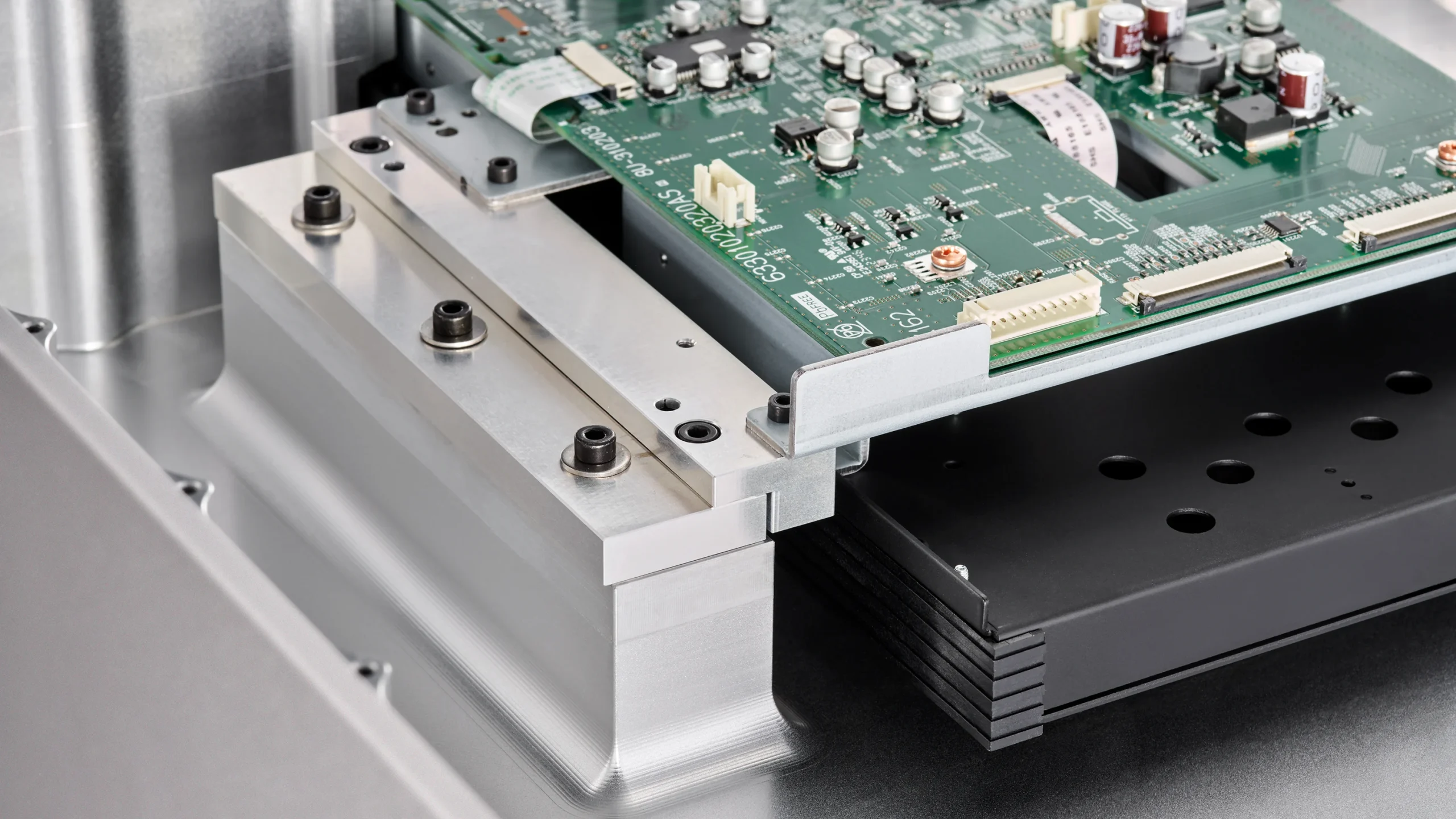
Using this mounting method has allowed us to create the quietest, lowest-vibration dCS Transport to date. The Transport generates even less noise and vibration than previous dCS Transports, some of which feature larger, more complex mechanisms complete with additional damping (such as the original Vivaldi Transport). This improvement is achieved through both the new chassis design, and the mounting method, with both features working in tandem with the mechanism to help ensure optimal performance during playback.
Electronic Innovations
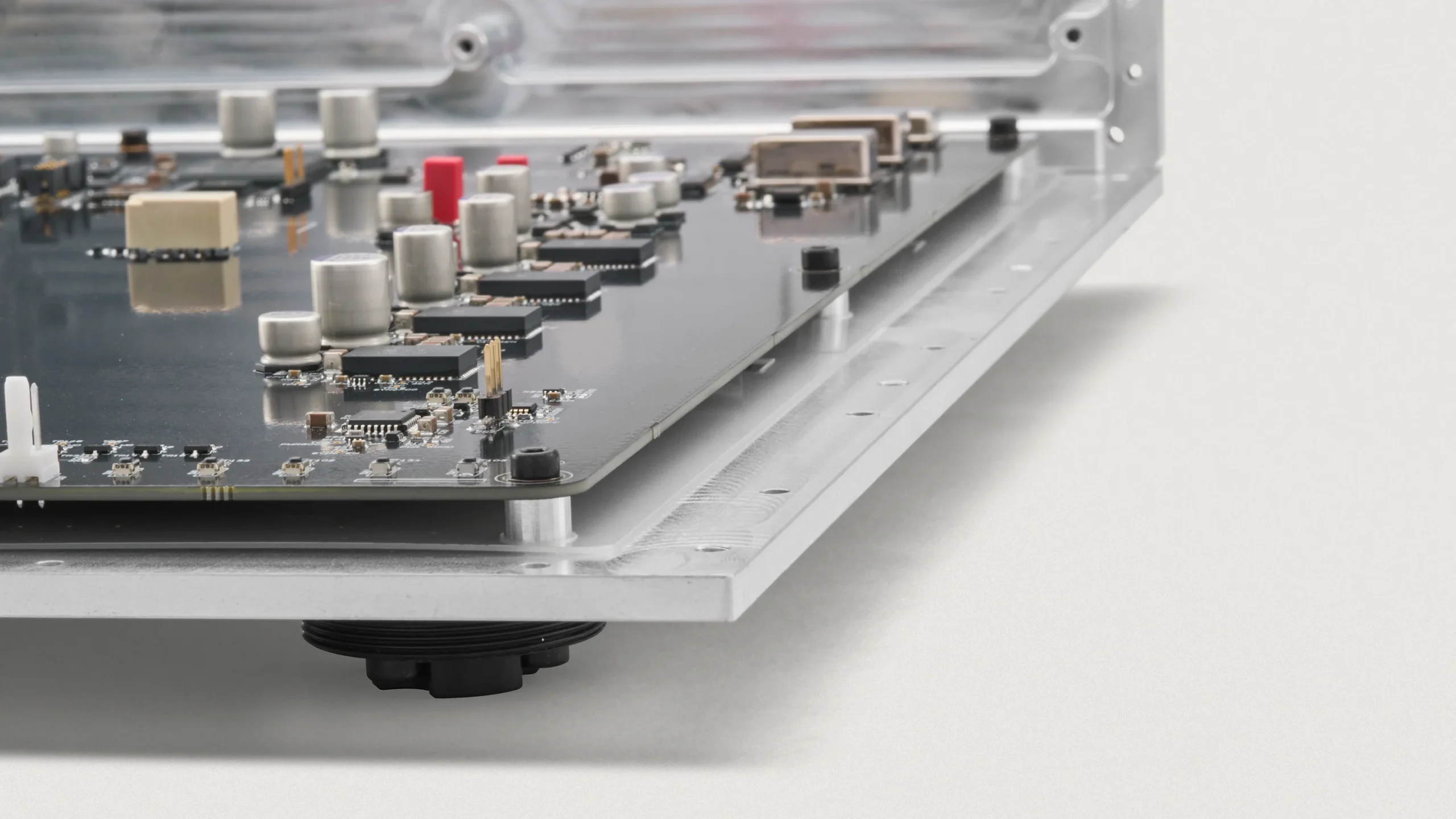
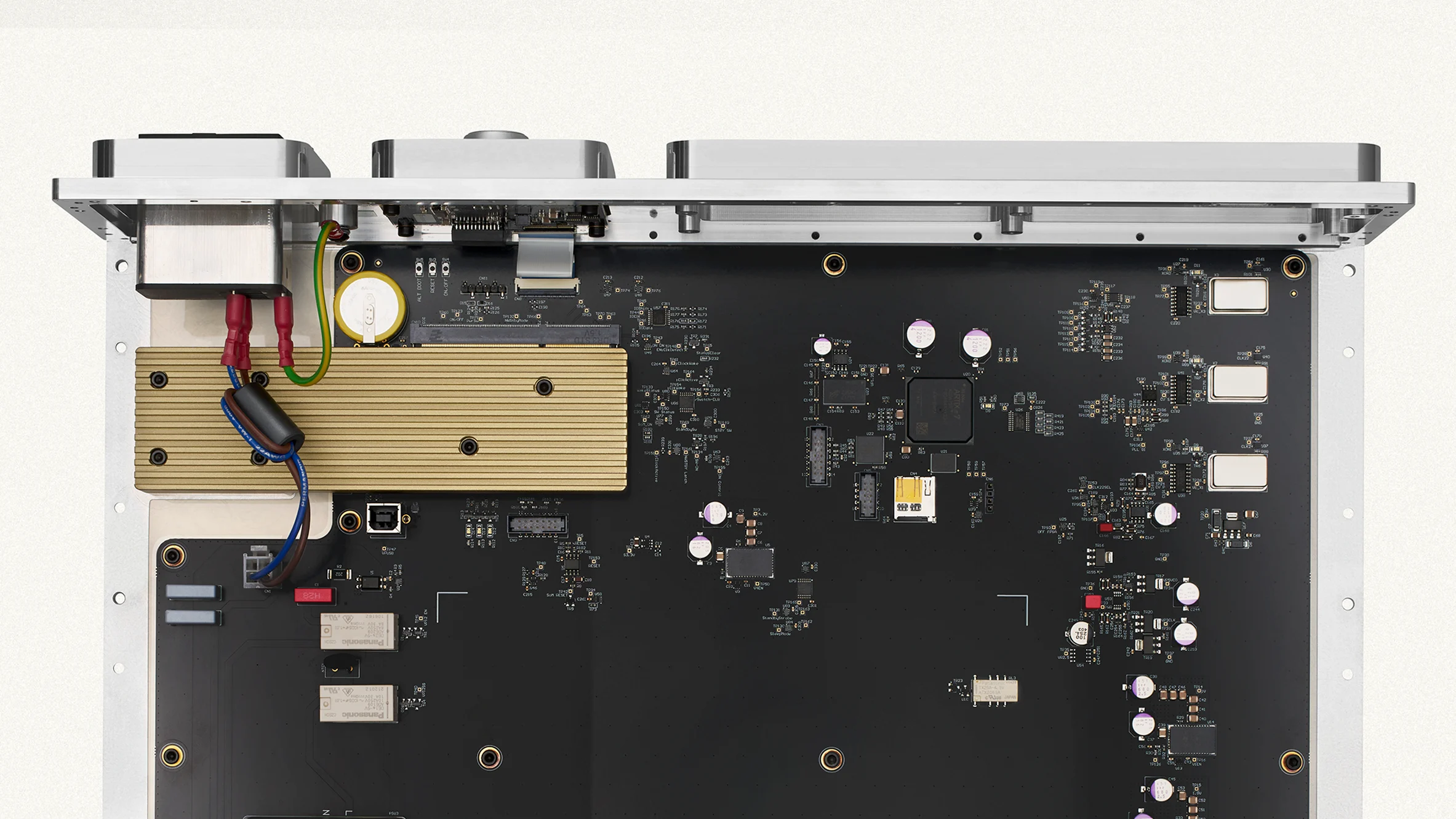
All dedicated CD/SACD Transports feature various electronic components. These tend to be arranged over multiple circuit boards which are mounted inside the product. In the Varèse Transport, most of the product’s electronics are unified on a single PCB. The only elements which do not sit on the main PCB section are the board housing the ACTUS connector, and the board housing the front panel LED.
The main PCB is mounted to the base plate of the Transport chassis, with standoffs separating the board from the base plate. These standoffs are milled from the same aluminium billet as the rest of the base/rear chassis piece. This ensures that the PCB is always mounted at a consistent height from the chassis, which aids performance by ensuring a consistent distance to the ground plane.
As previously mentioned, VCXOs running at 22.5792MHz and 27MHz are used to control the audio and mechanism respectively. The 22.5792MHz VCXO is synchronised to the Varèse Core or Clock through a Tomix clock signal fed to the Transport via ACTUS.
The power supply consists of two switching AC/DC converter modules. The internal switching regulators used for the power supply are, as with all dCS products, locked to the main clock inside of the unit. This eliminates the risk of any asynchronous noise or interference generated by the power supply affecting other components or areas of the Transport.
Like all Varèse units, an i.MX 8 runs the ACTUS interface – all ACTUS signals coming in or out of the Transport are decoded or encoded by the i.MX 8. Data is then sent to and from the FPGA for processing, with the FPGA controlling all of the main functions of the Transport.
Advanced Performance, Simpler Setup & Control
Developing Varèse was a multi-year project, which involved various teams at dCS working in tandem to explore how we could advance digital playback, whilst at the same time developing an even richer and more rewarding musical experience.
This ambition guided the design of each component, and the Varèse Transport is no exception. By looking carefully at all aspects of Transport design, developing an all-new chassis, and unifying the product’s electronics, we were able to build on breakthroughs made with previous dCS systems, and deliver our best performing Transport yet. Its unique features ensure bit-perfect transmission of musical signals – ensuring listeners are able to experience the best possible sound from their silver discs, with no unwanted excess noise or vibration. A perfect companion to the Varèse Core, Mono DACs, and User Interface, the Transport reflects our ambition to continue supporting silver disc playback, ensuring that dCS listeners who wish to play CDs and SACDs in their native formats can do so for many years to come.