
Karen Sumner, founder and CEO of Transparent Audio,, recently sat down with us to share a candid, inside look at how Transparent developed and grew to become a leader within the high-end audio industry. Transparent Audio designs, manufactures, and distributes audio, video, and digital cables and power conditioning products through a worldwide network of retailers and distributors. Here is Part 2 of her 4-part interview.
Many renowned audio studios use your cables. How did this come about?
Distinguished audio engineers like Bob Ludwig, Roy Halee, Ed Tuton, Brad Michel, and Peter McGrath use Transparent Cables. They and other dedicated recording industry professionals want to capture as much music information as possible for their media to be able to reveal every aspect of the performance. They constantly examine every link and its position in the recording and processing chain, including the cabling, that could stand in the way of the finished product being able to capture as much of the original performance as possible. Our design goal is to create products that reproduce all the music information embedded in source material. Our perspectives are natural extensions of each other. The Transparent design team has always relied on having access to new recordings created by our recording industry friends who share our perspective on bringing reproduced music to life. These trusted sources are a key design lifeline for us.
Bob Ludwig, who has one of the largest collections of Grammy Awards for his mastering accomplishments, approached us when he decided to leave MasterDisk and start his own studio in Portland, Maine, called Gateway Studios. We supplied cable for his entire new studio, from the studio connecting cables installed in trays under the floor, the monitor systems, and the reference monitor system in Bob’s studio which was outfitted with OPUS Cables throughout.
Our friendship now spans decades, and he has been instrumental in expanding our connections in the pro audio arena. Bob has recently retired, but the engineers who had the privilege of his mentorship are carrying the mission forward.
Bob was also one of the few, but powerful, voices associated with the Audio Engineering Society who advanced the idea that cables make a significant difference in sound quality. A large portion of the AES membership consists of people who are also prominent in the pro audio field, and it was a popular notion among AES members at least through the early 2000s that cables did not make a difference. When we started Transparent, I remember one noteworthy audio reviewer, who was also an outspoken AES member, wrote that a coat hanger could transfer an audio signal to speakers just as well as high-end speaker cable could. It has felt like a Sisyphean task at times to shift the commonly held belief about audio cables that audio cables don’t matter. Thanks in part to friends like Bob and other noteworthy industry professionals, we have made some real progress.
Is music a deciding factor in your product design?
Design is an ongoing process at Transparent and live, unamplified music performed in a natural acoustic space is always our reference point. We require that design, sales, and marketing team members attend live, unamplified music performances on a regular basis. Our design team spends many hours each week in our listening studio evaluating each design and making incremental changes in electrical values until it authentically embodies our listening criteria of tonal balance, dynamics, and space.
Master recordings of live, unamplified music, played in natural acoustic performance spaces, many of which are performances of quartets, smaller ensembles, symphonies, concertos, recitals, and operas that the design team has attended, help supply us with a very precise perspective on how well a design adheres to our standards for musical balance.
Although we love all types of music, for design purposes we do not rely on amplified or studio-produced music as a reference. When creating studio-recorded and amplified works, only the musical artists, sound engineers, and producers are truly aware of the kind of sound they want to achieve.
The infinite dynamic and tonal range and the subtle spatial cues of full orchestral music are the most challenging to record and reproduce. If a system can reproduce full orchestral music to a believable level, it can also reproduce all other types of music exceedingly well. Our focus on the most challenging music sources frees our customers to explore all genres of music with the confidence that they are hearing their favorite music as it was intended.
We have a very large collection of tapes and digital masters in our reference library. In addition, internet downloads give us unlimited access to the latest, highest resolution DSD and DXD files which reveal more of the recorded original music event than any other type of source. Although we personally have a very large LP collection, we do not use phono playback for design purposes because one can’t predict the “mood” of a phono cartridge and its tonearm set-up.
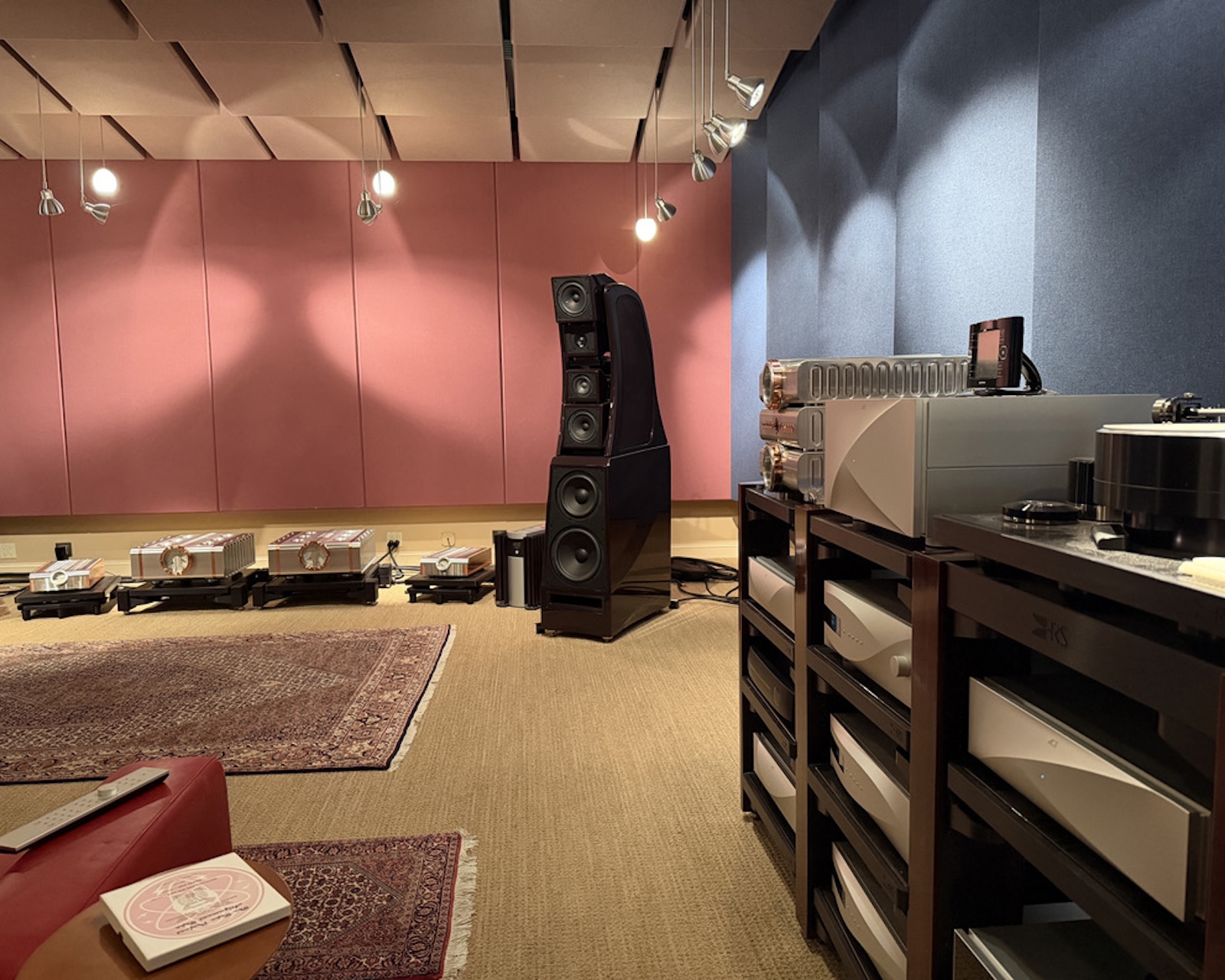
Listening is so key to the final development of our designs that we have invested in 2 nearly identically outfitted music studios, modeled after the studios at Gateway Mastering and designed by RPG. Both studios can reproduce full orchestral works with a level of dynamics, frequency range, and scale that comes amazingly close to recreating all the engagement of a live music listening experience.
In addition, we are constantly investing in noteworthy new components that our dealers and distributors represent to use in our studio reference systems to make sure that each product delivers the level of musicality we have theoretically designed into it.
Is noise the ultimate enemy of sound?
YES. FULL STOP. We define noise as any unwanted frequencies, including mechanical and electrical resonances. This includes ultra-high frequency interference, spurious audio signal resonances created by poorly matched components or cables, and mechanical resonances from within and outside components. Nearly every major advancement in high-end audio reproduction over the past 10 years in speakers, sources, amplification, and cables has in some fashion related either to reducing unwanted interference or preventing it from happening in the first place.
Noise not only masks desired frequencies from the source material, but it can also have an additive effect depending upon the location and type of the interference. Sometimes this additive effect is pleasant to hear, and sometimes it is more of a distraction, but in either case, it alters the artistic intent of the source material. Our overarching goal is to retrieve as much information as possible from the source material without introducing artifacts and noise that detract from or alter the music listening experience. We have reduced noise to a greater degree at each successive performance level by controlling mechanical and electrical resonances and by controlling the bandwidth of our audio cables at ultra-high frequencies that are well above the audio range.
We have always tried to align ourselves with manufacturers of other components in the audio chain that share this perspective. Over the years, a sort of symbiosis has evolved among us. Noise reduction and electrical and mechanical resonance control advancements by one have opened windows of possibilities for the others to create new products that come closer than previous efforts to retrieve all the information embedded in source materials without interference. I think largely because of this unintentional collaboration, we can now actually achieve a level of musical realism in high fidelity performance that has been an unreachable ideal for decades.
We have encouraged our North American dealers and distributors who are scattered around the world to also seek out these complimentary products. The result is that our dealers and distributors typically represent components that work together with the objective of creating the most incredible home music systems the industry has to offer.
We’d like to think that Transparent has had a part along with our like-minded industry colleagues in establishing some key performance standards within the high-end audio industry for home audio reproduction. I think this path is critical to help our industry continue to mature and better serve the needs of our customers whom we believe should feel confident about the value of their investment in audio regardless of their music preferences or budgets.
Do you use exotic materials, components, or unique design approaches?
Because we want our products to be as musically authentic as possible, we soundly reject the approach of using different metallurgy to achieve different types of sound. Now that it is more common to acknowledge that cables matter, our next notion to dispel is that choosing the right cable is a bit of a magical mystery tone-control tour based upon system dependencies and owner sound preferences. In contrast, the design intent of Transparent is to create cables that allow their connected components to meet their full design potential.
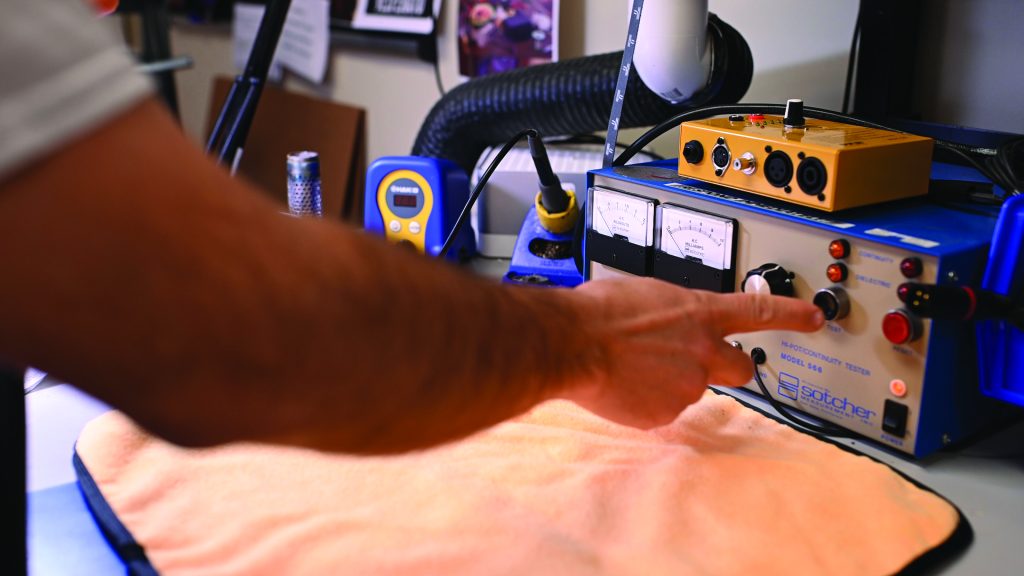
Our foundational conductor material is 99.997% oxygen-free copper that has been annealed to achieve an ultra-smooth conductive surface and to possess the strength and malleability we require to manufacture our complex and electrically stable cable geometries. We are, of course, always on the lookout for new conductor technologies that can provide enhanced conductivity and current carrying characteristics while at the same time meet our rigorous mechanical requirements necessitated by our tightly specified approach to cable geometry.
We design all connectors from the ground up to fit their respective cable designs precisely with an emphasis on durability, sound quality, and user friendliness.
I suggest your readers visit our website for more design perspectives and technical details: www.transparentcable.com.
Timbre, tone, and… the golden trinity?
Tonal balance, dynamics, and space are Transparent’s golden trinity.
Every Transparent product delivers first and foremost the correct balance of fundamental frequencies and harmonics. A system that falls short of delivering realistic musical tonal balance can’t engage the listener fully in the music experience. Typical audiophile-created systems can be exciting at first listen because they tend to strip away much of music’s foundation. Many of these systems are “tuned” to put an emphasis on higher frequencies and harmonics. Over the long term, our ears can’t be fooled, however, and most find the sound of these systems fatiguing. In contrast, a system cabled and powered with any performance level of Transparent transfers fundamentals with a realistic balance of high frequency and harmonic information, and in a Transparent level-matched system connected components achieve their full potential to deliver music at the frequency extremes in balance with the meat of the music.
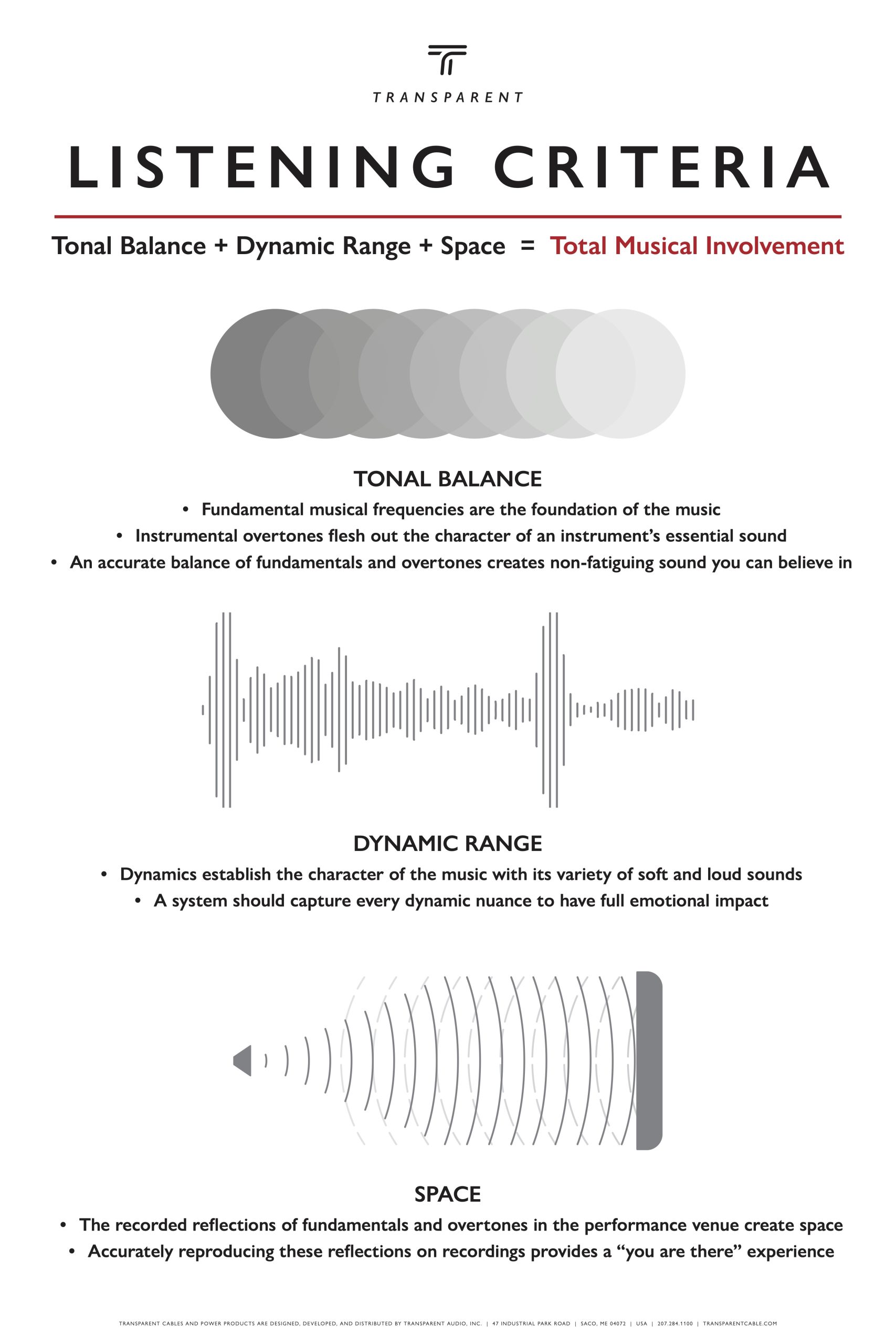
A system that accurately delivers a realistic balance of fundamental and low-level harmonic information is also more dynamic, from the quietest to the loudest passages. Transparent helps a system deliver true fundamental music balance while also helping it retrieve more low-level information from recordings so that dynamics have a chance to flow and expand in a manner that is more like listening to live music.
Space is the final, most difficult frontier to conquer in audio reproduction. Our innate ability to hear direction, distance, and size is a critical part of our survival, and these innate abilities fuel our musical engagement when we’re listening to a hi fi system.
Hearing performers in 3-dimensional space and being able to pick out the location of a soloist or the woodwind section, for example, is the most basic definition of space. To take the concept of space to the next step, a system should also be able to reproduce the realistic scale (size) of individual instruments and the scale of instrumental groups, the string or brass section, for example. Expanding the concept further, space means recreating the closest resemblance possible of the characteristics of the recorded performance acoustic space, including its scale.
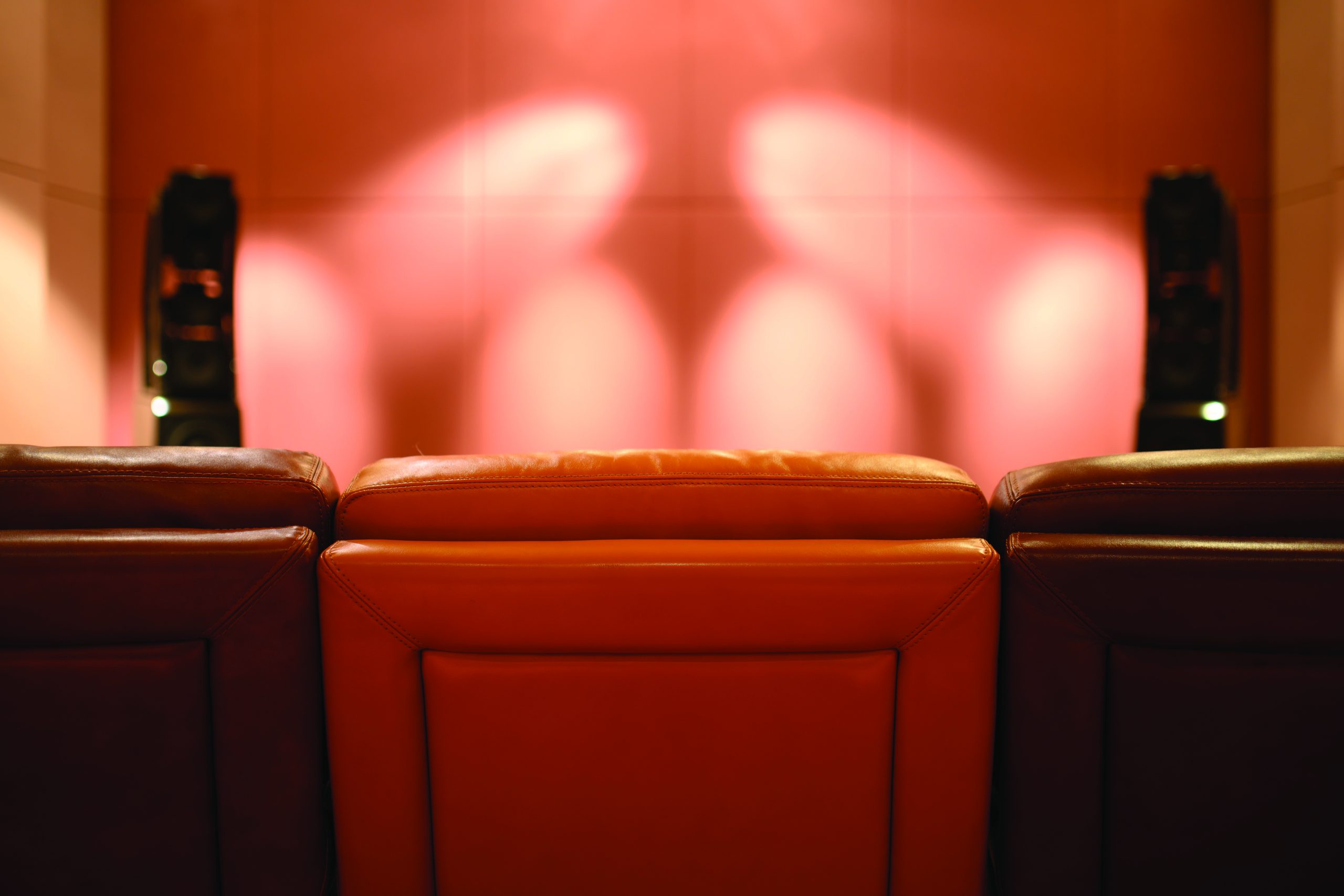
The combination of the best audio components available linked with a full suite of Transparent’s ultimate interfaces with it all expertly laid out in a professionally designed, dedicated listening environment delivers a level of musical realism that few achieve, many desire, and more would want if they knew such a home listening experience could exist. By ultimate musical realism, we mean full audio-frequency tonal balance, unrestricted dynamic expression, and the ability of the system to capture all the qualities of space. In the best listening studios, one should be able to listen to full orchestral works at a believable volume level with instrumental timbres faithfully reproduced. With the lights turned down, the listener should have a sense that the boundaries of the room melt away and that they have been transported to the best seat in the hall.
Achieving the ultimate in sound reproduction today requires a level of investment that few want or can consider, however. The price tag for a well-designed, dedicated listening room can easily add up to $1.5 million or more including the cost of room construction, room treatment, clean isolated AC power, quiet HVAC, and the best components and cables available. This expense does not consider the cost of the real estate required to accommodate the footprint of a room capable of delivering full audio frequency range accurately. A 30 Hz sound wave is approximately 38-feet long.
Achieving the ultimate, however, is not a practical pursuit for most. With the right guidance, a profound level of musical enjoyment is within reach even with a simple, basic system consisting of 2-way speakers that are well set up in a more typical living environment. The key is that all components, including the cables, fundamentally must work together to deliver true musical tonal balance. Speaker choice and placement is vitally important to get the broadest possible frequency response given the size and acoustic characteristics of the listening room. Most home listening environments can’t reproduce low frequencies well. These frequencies can load up in a typical room and create out-of-phase frequency nodes that destroy instrumental timbres and low-level information. Low frequencies more frequently tend to escape through doors, walls, and windows resulting in a lightweight tonal balance that is not musically convincing. In addition, most home listening environments require some room reflection management to be able to reproduce satisfying spatial qualities.
The room that houses a home music system is as important as anything else in the system. Achieving the best sound possible given a customer’s time, budget, interests, and listening space is really a process that requires the expert guidance of professional dealers and distributors who specialize in curating the best home music systems.
Tell us about your reference high-end audio system and listening room.
Transparent is dedicated to being able to reproduce the ultimate level of music reproduction to carry on our mission of helping our customers put together the most musically satisfying home audio systems. To that end, we have the best audio components available today linked with a full suite of Transparent’s ultimate interfaces expertly laid out in 2 professionally designed, dedicated listening rooms. Both facilities can reproduce the full spectrum of audio-frequencies accurately from well below 30 Hz to beyond the limit of hearing, provide unrestricted dynamic expression, and capture all the qualities of space that are vital to delivering a “you are there” listening experience. We outfit 2 rooms nearly identically so that our head of design, Jack Sumner, can work remotely more efficiently to corroborate the findings of his design team from the dedicated sound room at Transparent headquarters. These investments, the level of which are rarely matched in today’s high-end audio industry, are instrumental for our existing and future research and development.
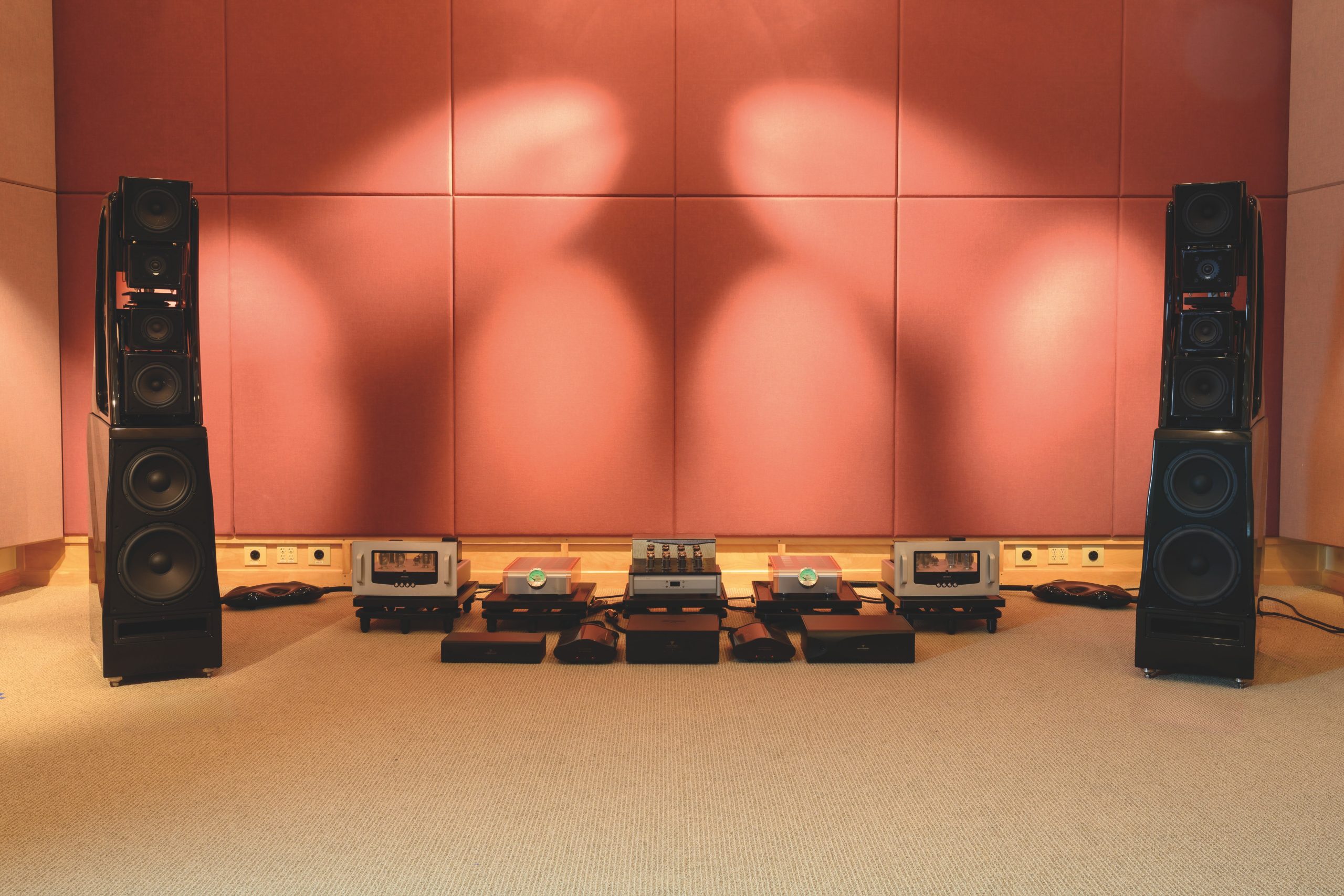
Five layers of staggered 5/8” sheetrock screwed and glued on an overbuilt stud and truss structure define the incredibly rigid outer acoustic space of the rooms. The rooms are completely isolated structures within their respective buildings with separate reinforced foundations and separate electrical and HVAC systems. An RPG acoustic shell in each room controls room nodes and spurious reflections.
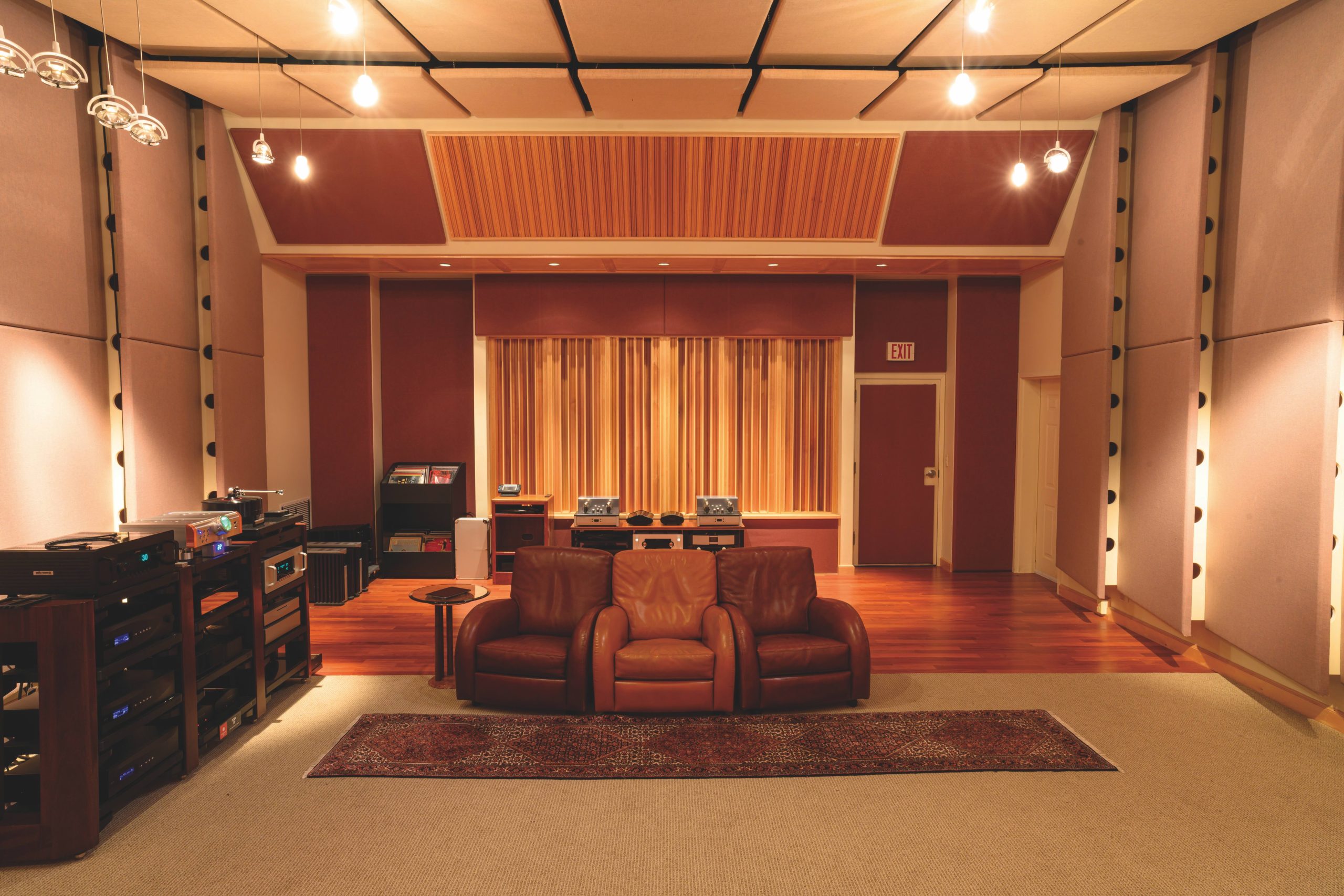
As far as the specific components housed within, we rely on the brands and models that many of our dealers and distributors represent, including such industry leaders as D’Agostino, dCS, Wilson Audio Specialties, Audio Research, and Rockport Technologies.
In our next issue, look for Part 3 of this interview to read more about Transparent Cables, Power Conditioning, and System Building.