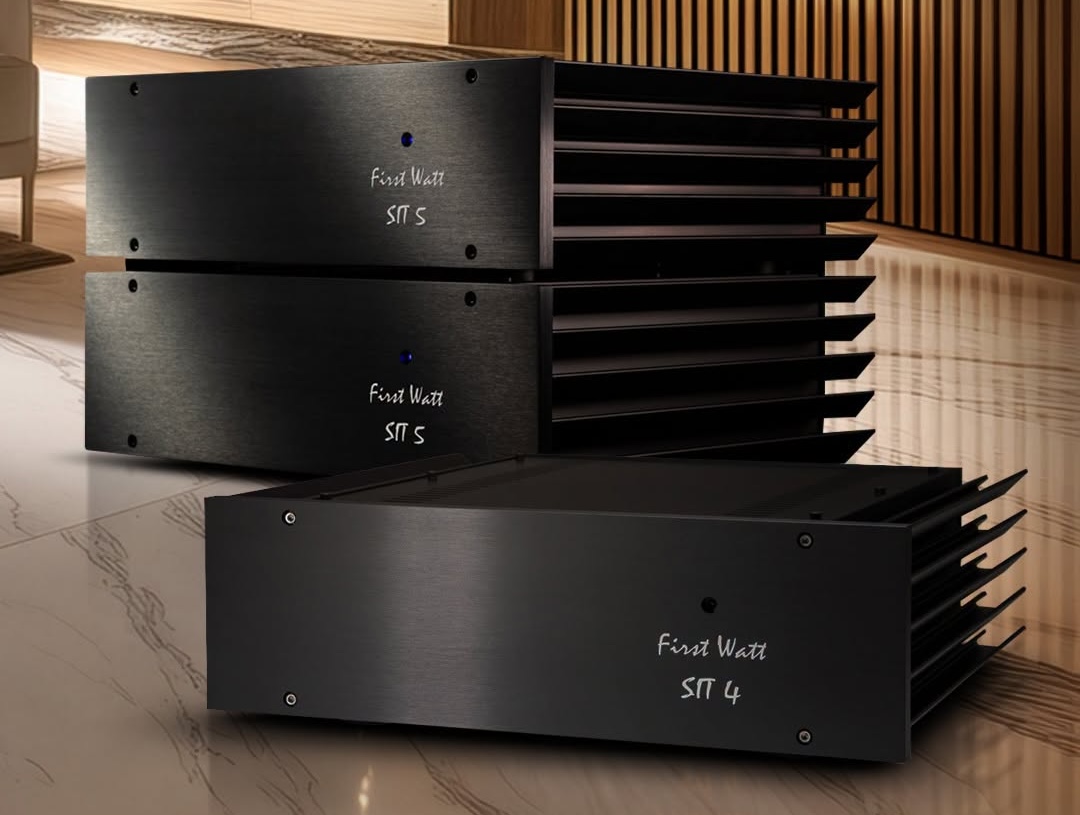
Two First Watt SITs. Two very different ways to hear the music. Plenty of ways to choose an amplifier. More watts. More features. More numbers. First Watt has always taken a different path.
The SIT-4 and SIT-5 are two amplifiers built around the same unusual Static Induction Transistor technology, yet each takes that idea in a distinctly different direction. And if you love music, both are worth hearing.
The SIT-4 is the purist. A single-ended Class A, Common-Source design using one SIT without negative feedback, it delivers 10 watts into 8 ohms and is designed for efficient, higher-impedance loudspeakers. Its character comes from what makes a low-power amplifier so captivating: detail, warmth, depth, and imaging, with a remarkably direct connection to the music.
The SIT-5 takes the same fundamental SIT concept somewhere else. Its SIT operates in Common-Drain mode, again without negative feedback, giving it lower measured distortion, wider bandwidth and lower output impedance than the SIT-4. Most importantly, it has considerably more muscle: 35 watts into 8 ohms at 1% THD, with the ability to deliver 60 watts into 4 ohms.
So which one is better? That isn’t really the question.
As Nelson Pass explains, the difference isn’t simply about power. It’s about the relationship between the amplifier, the loudspeaker, and the listener. The SIT-4 can be an especially compelling match for listeners who already appreciate the immediacy of 5- or 10-watt triode amplifiers and efficient speakers. The SIT-5 is the more natural choice when you need greater power for less-efficient or lower-impedance loudspeakers.
And that’s precisely why we think music lovers should hear both.
The SIT-4 and SIT-5 offer two interpretations of the same fascinating device, both designed with an unapologetic focus on the listening experience.
Because sometimes the best way to choose an amplifier isn’t by reading the numbers. It’s by sitting down, putting on an album you know by heart, and discovering that you weren’t listening quite as closely as you thought.
That’s when First Watt gets interesting.