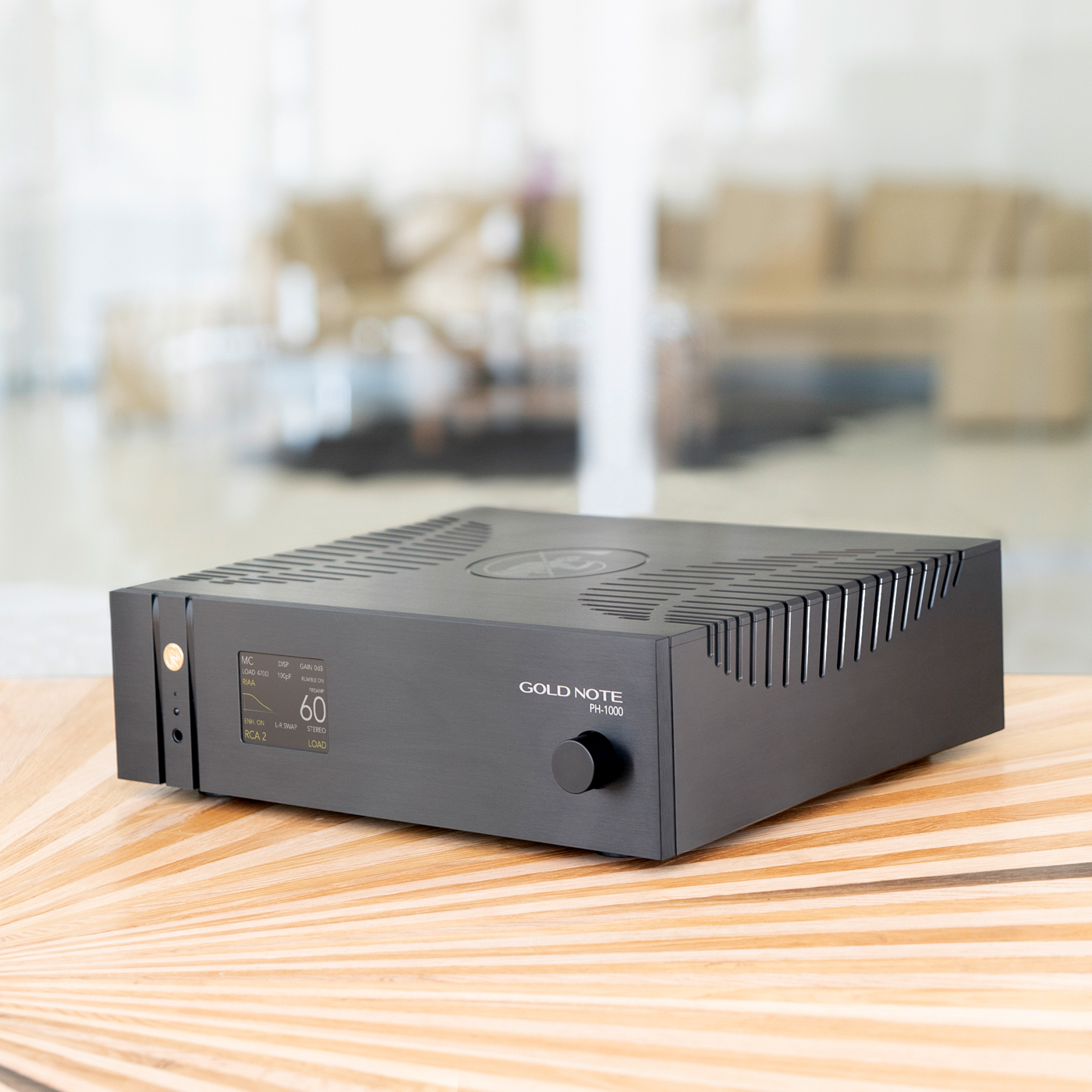
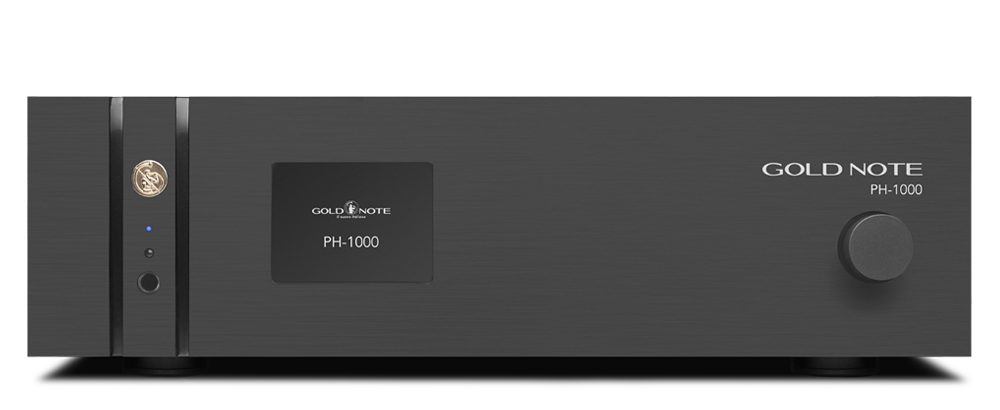
A closer, in-depth look at the Gold Note PH-1000 phono preamplifier from the unmistakably Italian brand Gold Note, based in Tuscany. This phono stage is a highly interesting, innovative, and, as you can read throughout this review, an excellent-sounding high-end analog audio component.
PH-1000
The PH-1000 was designed from the ground up to be the best phono stage Gold Note has ever developed – a unique piece of audio technology, innovative in every way and 100% made in Italy.
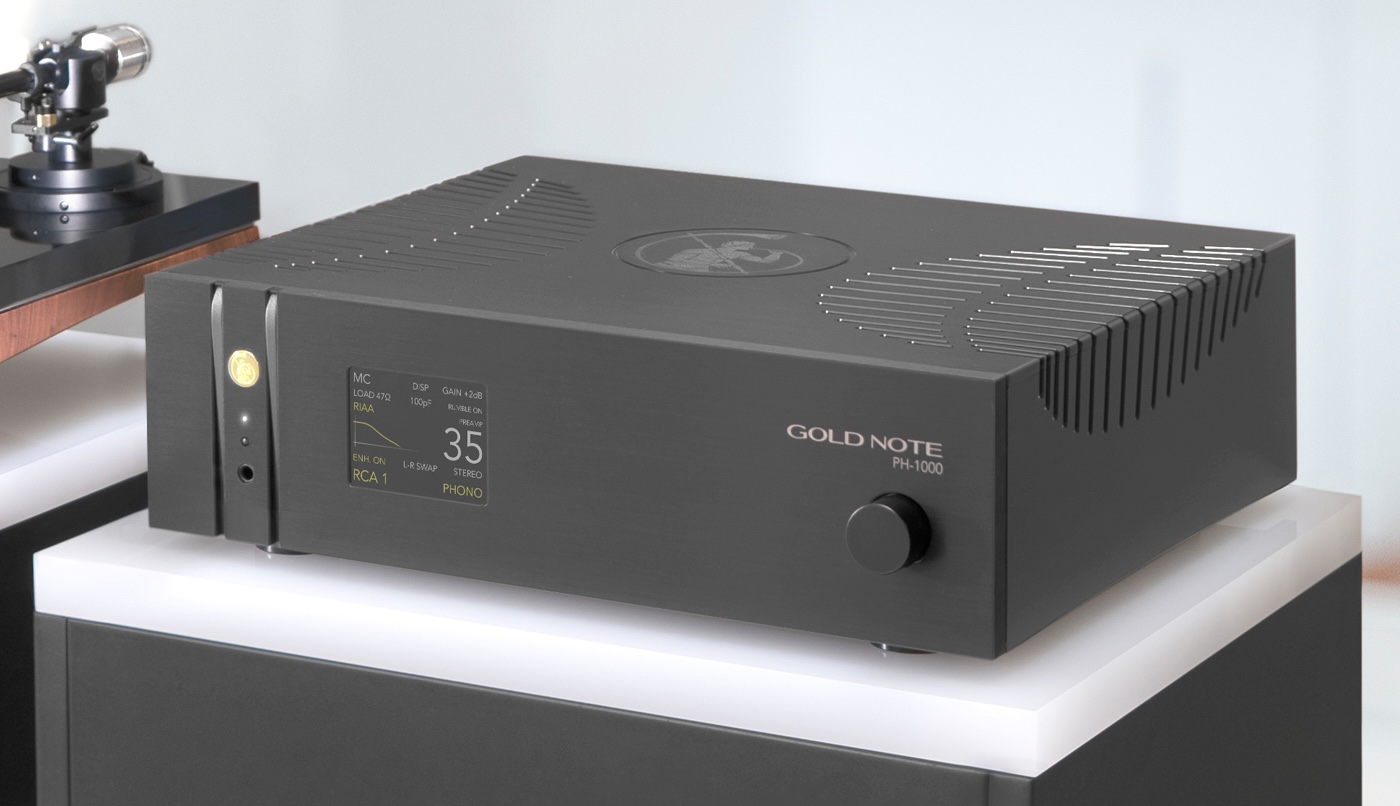
The PH-1000 features exclusive discrete modules, including a Class A headphone output, more than 40 EQ preset curves, four manually adjustable custom EQ curves, and an optional high-quality Class A line preamp. This Class A line preamplifier is of the highest quality and allows volume control directly from the phono stage. The line preamp can be turned off by selecting STAGE from the PREAMP menu. The PH-1000 can also be muted by selecting MUTE from the same menu or by using the corresponding button on the remote control.
All functions are managed by discrete audio-grade components and sealed individual switches that keep the signal path as short as possible to deliver superior audio quality and reveal even the finest details from the record. The PH-1000 is powered by Gold Note’s proprietary firmware and can be easily updated via computer if required.
The level of quality is exceptional throughout the production of the Gold Note PH-1000—from the ultra-solid, precision-engineered aluminum chassis to the electronic components and circuitry, which undergo rigorous computerized QC testing.
HANDS-ON
The Gold Note PH-1000 flagship phono stage is easy to use and offers a wide range of features, a high level of customization, and a comprehensive selection of inputs and outputs.
The PH-1000 provides three independent inputs – two RCA and one XLR. There are also two additional inputs, one RCA and one XLR, which can be used either for external load plugs for even finer control of the load or as line inputs when the PH-1000 is used with a preamp.
Additional features such as the headphone output, stereo/mono control with phase inversion, L/R channel switching, and noise reduction filter make the PH-1000 one of the most advanced phono stages on the market.
Thanks to the new audio inputs on the rear panel, valve output stages can be connected to up to two sources simultaneously. The TUBE INPUT is dedicated to Gold Note sources, and the LINE INPUT is for front ends from other manufacturers. The input can be selected easily from the front panel for maximum convenience.
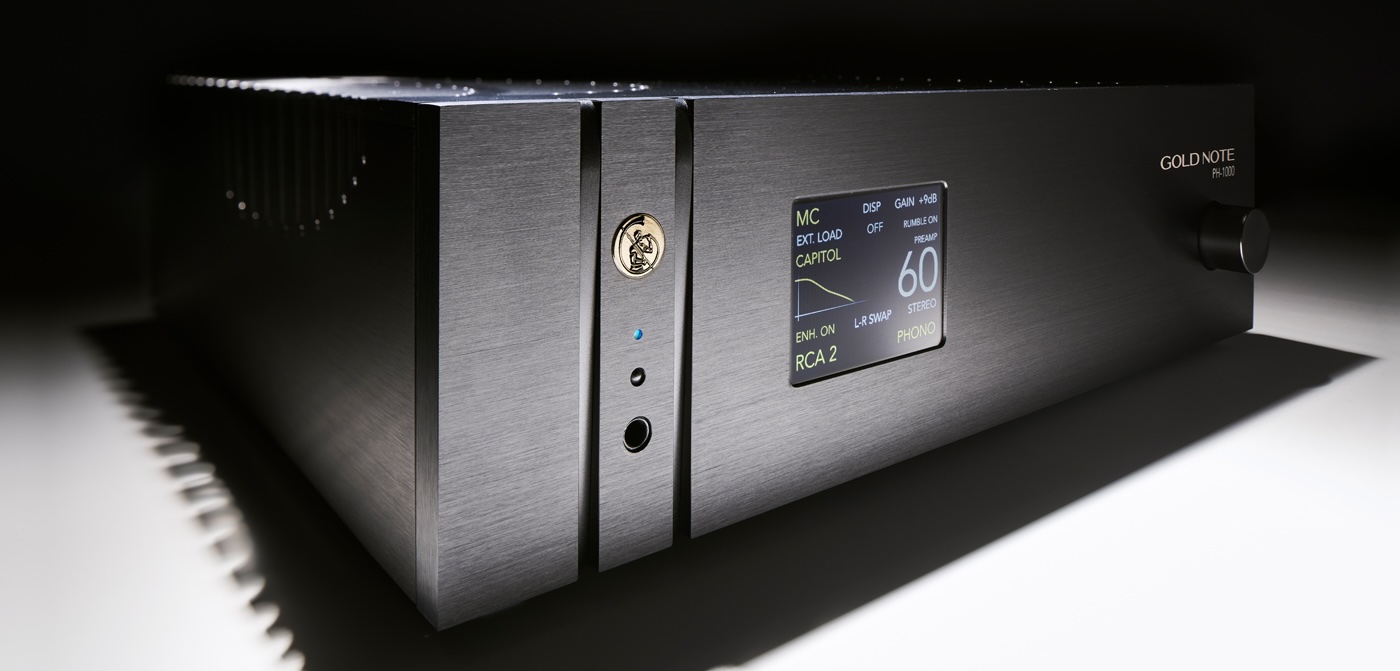
The PH-1000 displays every detail on a color screen controlled by Gold Note’s proprietary firmware. With SKC (Single Knob Control technology) and the intuitive display system, operation of the phono stage is straightforward, and fine adjustments can be made quickly without interrupting playback.
With more than 40 available EQ curves, virtually any record can be played back as it was intended. The EQ curves can also be manually adjusted by setting three main parameters, making the PH-1000 an indispensable tool for the most demanding vinyl aficionados and analog connoisseurs.
Available curves include RIAA, Capitol, Columbia/CBS, Deutsche Grammophon, Decca London USA, Decca London UK, Decca Mono 78rpm, Epic, HMW, Mercury, RCA Victor, Philips, Elektra, L’Oliseau-Lyre, Parlophone, and more.
Each curve can be “enhanced” with Gold Note’s proprietary technology, inspired by the special Neumann cutting lathe curve, to improve dynamics and musicality.
The unlimited curves feature is a unique innovation from Gold Note. Using analog technology, Gold Note engineers have developed a special design that allows the creation of unlimited equalization curves by simply adjusting three parameters – Bass Turnover, Bass Shelf, and Treble Cut – as this is the most effective way to control and shape the equalization curve.
Fourteen gain stages and twelve load stages, as well as seven capacitance options for MM cartridges, make the PH-1000 the quintessential phono stage for high-performance, high-end analog systems, capable of driving even the most exotic cartridges with perfect synergy. With this flexibility, the PH-1000 is also a professional tool that will easily find its place in high-end recording studios.
Changes to settings and fine adjustments, including the EQ curve, are easily made using SKC and the display while music is playing. Gold Note’s innovative technology allows for optimal ease of use while fully preserving sound quality by operating in the analog domain: the interface is digital and independent of the audio path, which is fully analog. The result is an extremely low-noise phono stage with high gain and no audio filtering.
As the icing on the cake, the PH-1000 comes with a dedicated headphone amplifier, where the pure signal from the cartridge is routed directly to the high-quality head amp for immediate, uncluttered analog listening.
PH-1000 x PSU-1250 x TUBE-1012
As soon as I heard the PH-1000 on its own, my mind started buzzing with thoughts of the PSU-1250 and TUBE-1012 optional upgrades. I am glad I requested these two additional components as part of the PH-1000 evaluation.
Both devices are designed for demanding audiophiles who want to take a step further in every respect.
The PSU-1250 is a super-inductive external power supply for the Gold Note 1000 series, including the CD-1000, DS-1000, PH-1000, and P-1000. Gold Note developed a sophisticated design for the PSU-1250, engineering a refined power supply driven by a double inductor that handles the negative and positive high-current stages, with an inductive filter on the analog stage.
The PSU-1250 features a seven-transformer design, with four transformers dedicated exclusively to the power supply stage, one for the galvanic isolation of the audio stage, and three for the dual inductive choke filter.
The PSU-1250 power supply perfectly filters the AC current and removes interference and electrical noise from the power grid, allowing Gold Note electronics to perform at their best.
Most importantly, the PSU-1250 ensures that the electronics are always supplied with the optimal amount of current without generating EMI (electromagnetic interference) or RFI (radio frequency interference) that could affect the audio signal.
The TUBE-1012 was conceived and designed as an optional upgrade to elevate Gold Note electronics to a new level of performance through a pure Class A output stage with no fewer than twelve tubes.
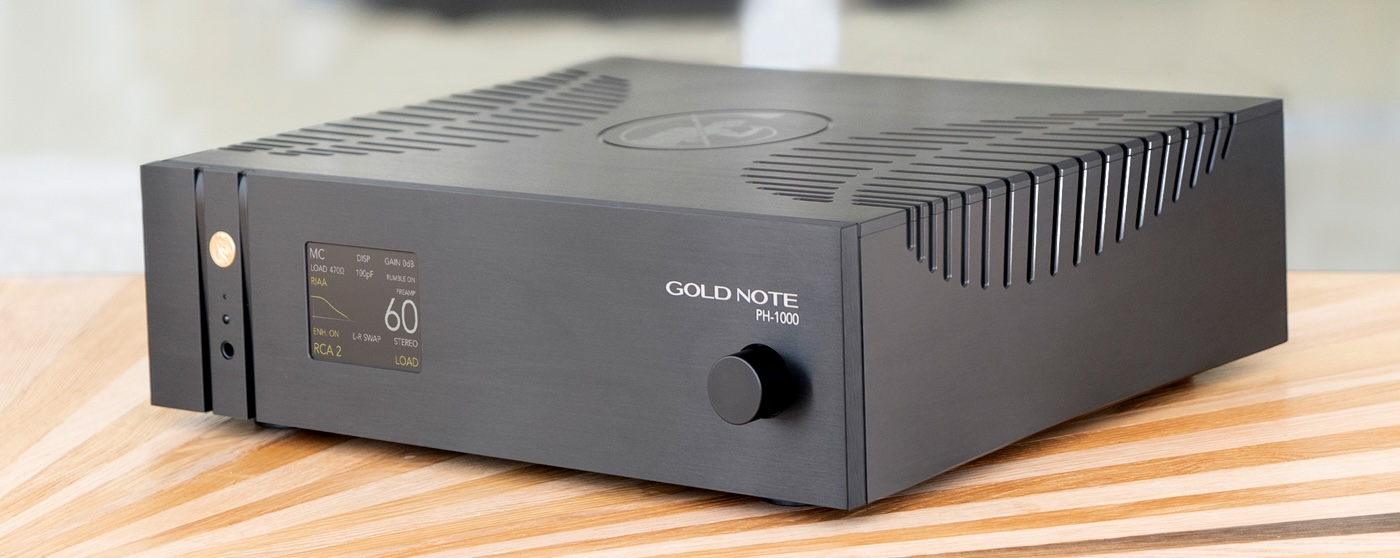
Make no mistake: with the PH-1000 there is no lack of control, authority, definition, or ability to reproduce sheer drama.
However, if you are seeking a warm tube sound, a slightly more courteous tone enriched by second harmonics, synergistic interaction with cooler-sounding solid-state circuits where odd harmonics more often than not take their toll, or simply a unique synergistic juxtaposition of tube and solid-state, then the Totem-Pole output stage (+2 dB gain) of the TUBE-1012, with six independent audio stages per tube, guarantees an extremely wideband response and extremely low distortion to deliver the purest audio signal.
With the Gold Note PSU-1250, the tremendous energy – not just temporarily stored or suspended – is immediately released and, in stark contrast to the overall dynamics, the horizontal and vertical soundstage is expanded and a new level of detail is unclenched.
While the PSU-1250 opens up the dynamic micro and macro cosmos, the TUBE-1012 introduces a further magnetism that draws the listener deeper into the music.
With both the PSU-1250 and the TUBE-1012, details were brought out with added sharpness in the leading edges of notes, parallels between real and reproduced music diminished, and the scope of reality was framed with a far more sensual and coherent narrative.
In addition, the underlying complexities of the music were much better fleshed out, and the newly gained density of information demanded far fewer reality checks. The music simply became more conclusive, more cohesive, and reached a new level of harmonic wholeness.
THE MUSIC
The usual, feedback-based, highly sought-after section of the Mono & Stereo reviews deals directly with the music and its relationship to the specific component being evaluated.
As a rule, here are some of the reference music pieces that demonstrate the sonic qualities and advantages of the Gold Note PH-1000.
LOVE FOREVER CHANGES
Let me start with Love’s Forever Changes (ERC057). The Gold Note PH-1000 offers a remarkable sense of realism that is rare even on vinyl.
Forever Changes is the third studio album by the American psychedelic rock band Love. It failed to achieve commercial success when it was first released by Elektra Records in November 1967, but today it is widely considered one of the greatest albums of all time. In 2003 it was voted number 40 on Rolling Stone magazine’s list of the 500 greatest albums of all time, and in 2008 it was inducted into the Grammy Hall of Fame.

The PH-1000 reveals far more of Forever Changes than I expected or am normally accustomed to. It is not that the expectation bar for the PH-1000 was low to begin with; I simply did not imagine there was more to be extracted from this already great-sounding record. Especially with the dedicated power supply, the dynamics, the depth of the soundstage, and the three-dimensional imaging – both horizontal and vertical – extend far beyond the speakers.
The separation of the instruments, and perhaps most of all the way vocals and instruments are individually rendered on a solid foundation, was an extraordinary surprise.
BILL EVANS TRIO – PORTRAIT IN JAZZ
A special quality was also introduced with the PH-1000, which became even more apparent with the Bill Evans Trio – Portrait in Jazz (ERC052S): nimbleness.
The Trio’s lyrical expression and one-of-a-kind interconnectedness were enhanced by the unadulterated, non–post-processed dynamics, with a wealth of detail and dynamic contrast normally reserved for far more expensive phono stages.

The way the Gold Note PH-1000 conveyed the subtle yet forceful cymbals, the centered and full-bodied piano, and the holographic imaging was more than impressive. It delivered a truly beautiful, tangible, and vivid rendition that stayed with me far longer than I am used to and left stronger impressions than usual.
SHOSTAKOVICH’S SYMPHONY NO. 13, “BABI YAR
The impressive sonic discoveries continued with Shostakovich’s Symphony No. 13, “Babi Yar,” with André Previn conducting the LSO (ERC056).
No other Oscar- and Academy Award–winning conductor and composer from the Hollywood film studios became as successful and respected in the classical music world as he did with the London Symphony Orchestra, which he led from 1968 to 1979 while pursuing a parallel career as a jazz pianist.
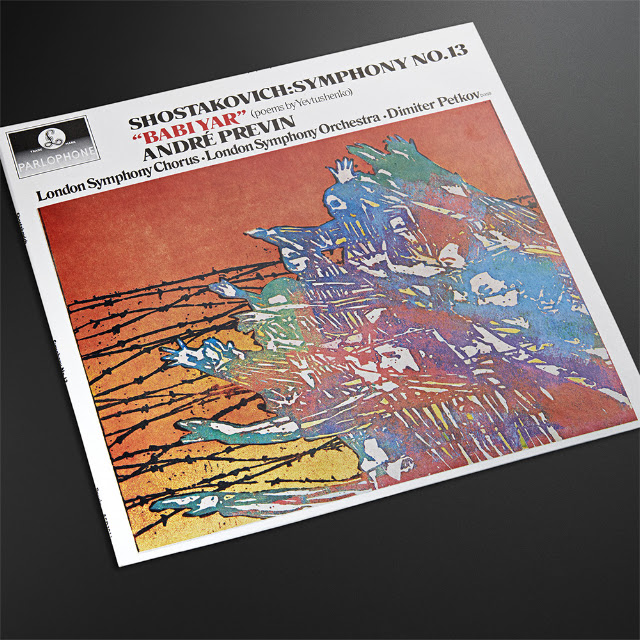
Through the Gold Note PH-1000 phono preamp, “Babi Yar” revealed previously hidden and difficult-to-communicate aspects of this recording, with an invigorating amount of back-and-forth interaction. All of this was achieved at the top level usually reserved for prestigious, high-priced phono preamps.
“Babi Yar” refreshingly did not sound like another Magdeburg Hemispheres experiment. The PH-1000 created a different kind of vacuum, in which psychoacoustic cues, nodal points, and acoustic focal points were presented with sufficient density to reproduce the sheer drama and dynamic impact, all emerging from an unobstructed black vacuum, as in a real concert experience, with instantly shifting dynamic magnitude that in some respects rivals and surpasses the best features of modern DACs.
THE WHITE STRIPES — WHITE BLOOD CELLS
A slightly different form of dynamism, similar at its core, was further solidified by The White Stripes’ White Blood Cells (ERC073). To celebrate the album’s 20th anniversary, The Electric Recording Co. collaborated with Third Man Records to produce this unique edition.
The White Stripes’ third studio album returns to basics: hard, lush, vibrant guitars and simple yet catchy drums.
Considering that this is a duo, the drums and guitar still feel complete and captivating.

Even when played loud, the sound – masterfully captured on analog tape – is easy on the ears, and from track to track, all nine songs are immediately engaging. The Gold Note PH-1000 reproduced White Blood Cells with unrestrained, unquestionable authority and control.
As with “Babi Yar,” White Blood Cells never felt dynamically congested or failed to deliver uniformity across the full frequency range.
For the finale, I chose Kip Dobler’s Reaching Out From the Inside, recorded on October 7, 1990, at Bridges Hall of Music, Pomona College, Claremont, California, USA. Dobler was recorded by George Cardas with a Cardas-wired Calrec Soundfield MK-4 microphone.
CONCLUSION
Italian high-end audio manufacturer Gold Note has been a distinctive force in the market for nearly 30 years.
Over the last two decades, under the direction of Maurizio Aterini, Gold Note and Akami have launched many intriguing products.
In recent years in particular, Gold Note has made a strong impact with refreshed, beautifully styled products that include electronics, cartridges, turntables, and speakers.
There is something genuinely Italian about Gold Note that is closely tied to both sound and aesthetics. Their products are instantly recognizable and clearly connected to the deep roots and influence of Aterini’s beloved Florentines. The environment of Tuscany is historically among the most deeply etched with innovations and technical discoveries.
On their path, and with respect for heritage and tradition, Gold Note continues this unique legacy, reviving in musical form the true Italian Renaissance tradition that is more than 600 years old.
The basic function of the RIAA curve (and other EQs) is not directly related to sonic character but is primarily about establishing level balance with the least possible surface noise while keeping the music intact.
Of course, this is only one important part of the phono stage. Everything must be highly optimized and finely tuned to handle the sensitive information coming from the cartridge. The phono stage is perhaps the most sensitive of all high-end electronics and the most difficult to fully master.
The phono stage should not add any noise to playback. When the cartridge is wired fully balanced, the noise is generated by the records themselves, not by the phono stage. This is how vinyl playback should be in the 21st century.
Once noise is eliminated, the sound can be refined. This is where true engineering skill comes into play, along with the ability to properly tune the phono preamp. The phono preamp needs to be transparent and see-through, yet every component in the signal path can and does change the sound. Therefore, regardless of price, finding a well-balanced, great-sounding preamp is not easy.
The Gold Note PH-1000 phono preamplifier, including its two ancillaries, somehow embodies the Japanese concept of 間 – Ma.
What has been described as a pause in time, a place where everything originates, or – perhaps most aptly with the PH-1000—as emptiness in space, is the crux of this remarkable phono preamp.
Ma deals with the fundamental time and space in which life can grow, and much like the PH-1000, it offers a uniquely silent core where the soundstage is not restricted and music can emerge from a pitch-black, deep black backdrop.
Most importantly, as always with Gold Note, music reproduction reflects the fundamentals of the music itself. The essence of the Gold Note brand is expressed in the liveliness and naturalness of the aural imagery projected through the PH-1000.

With what the PH-1000 establishes on its own and further enhances with the addition of the PSU-1250 and TUBE-1012, it comes remarkably close to the sphere of a final arbiter in the analog domain. In addition, the flexible EQ curve settings, which include four custom, self-programmable options, will please any analog lover trying to get the “right” sound from their beloved records.

The Gold Note PH-1000 preamplifier is a genuinely well-designed, great-sounding, contemporary phono preamplifier, packed with features and upgrade options, offering a unique product category that is hard to match.
For what it achieves musically and technically, I am more than happy to grant the Gold Note PH-1000 the rare and prestigious Editors Choice Award. ⧉

PRICING
PH-1000 LINE – € 14.500,00
TUBE 1012 – € 6.390,00
PSU – 1250 – € 5.990,00
SPECIFICATIONS
FREQUENCY RESPONSE: 20Hz – 20kHz
EQ CURVES: 36 EQ curves
4 custom EQ curves all with Enhanced option @ +/- 0.3dB max.
THD (TOTAL HARMONIC DISTORTION): less than 0.01% max.
SIGNAL TO NOISE RATIO: 100dB
DYNAMIC RANGE: 110dB
INFRASONIC FILTER: 10Hz/36dB octave (ON/ OFF)
MONO/STEREO: Stereo, Stereo 180°, Mono, Mono 180°, Mono L
CHANNEL SWAPPING: R/L, L/R
IR RECEIVER: For multifunctional remote control
CONTACT
Akamai s.r.l
Via Virginio 158
50025 Montespertoli – Firenze
Italy
Email: info@goldnote.it
Web: www.goldnote.it