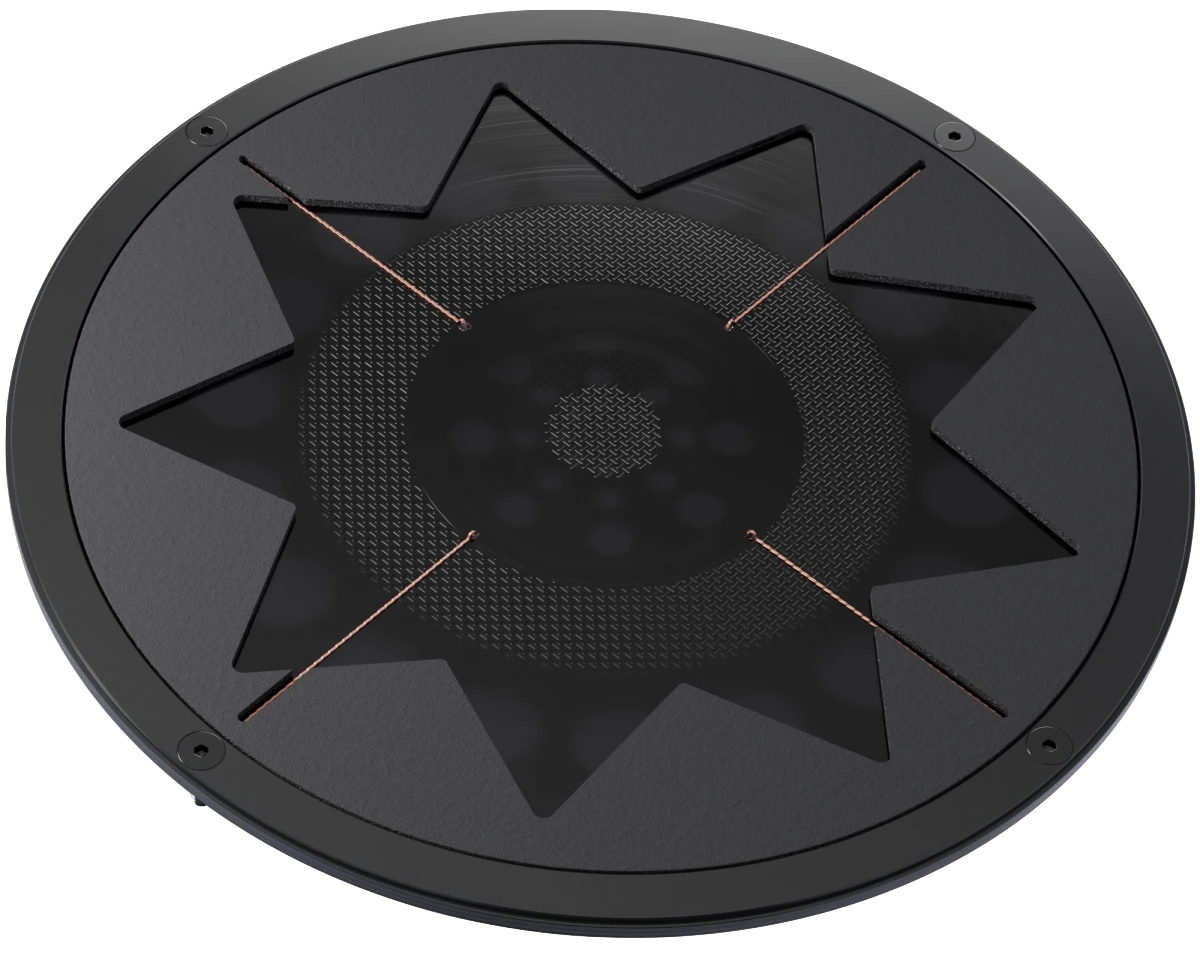
The Manger sound transducer was developed to reproduce sound with high temporal precision. Its bending wave principle creates a coherent sound image with natural spatiality and precise impulse behavior.
A Different Principle
Most loudspeakers follow a principle that has remained unchanged for decades:
they move air in a piston-like motion.
The Manger sound transducer takes a different approach.
It is not based on piston motion, but on the propagation of bending waves across a specially designed diaphragm.
The difference is not in the details – but in the principle.
Designed from the Human Ear
The starting point was not loudspeaker engineering, but a fundamental question:
How does human hearing work?
What matters is not primarily pitch – but the temporal structure of a sound event.
“We have overcome transient distortions. What you hear is only the music.”
The ear detects sound sources through minute temporal pressure changes – within fractions of a millisecond.
This is precisely what the Manger transducer reproduces.
Time Before Frequency
In conventional audio engineering, the focus is often placed on frequency response.
For human perception, however, hearing begins differently:
with time – not with frequency.
The very beginning of a sound event already contains essential information:
- direction of the sound source
- spatial structure
- character of the sound
Only afterwards does pitch perception occur.
If this temporal sequence is not reproduced accurately, the sound loses its naturalness and precision.

The human auditory system processes sound in a temporal sequence: first the onset, then spatial and structural information – and only afterwards pitch.
The Principle of Bending Waves
In the Manger transducer, the diaphragm does not move as a rigid body.
Instead, bending waves propagate outward from the center.
The diaphragm is designed so that its properties change radially:
- Low frequencies use the entire surface
- Higher frequencies increasingly originate from the center
The result is a coherent sound image – without transitions between different drivers.
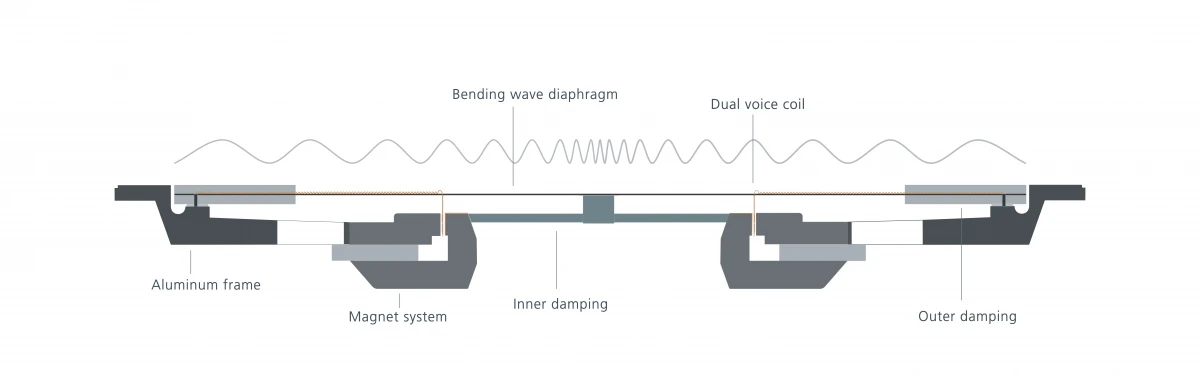

The Manger diaphragm operates through radial bending waves – not piston motion.
A Structural Issue in Conventional Loudspeakers
Conventional loudspeakers use multiple drivers, each covering a specific frequency range.
This division is not a detail – it is a structural issue.
It inevitably leads to:
- time offsets
- phase inconsistencies
- incoherent reproduction
The Manger transducer minimizes these transitions.
A single driver reproduces an exceptionally wide frequency range – coherently and seamlessly.
Precision in Time
Many loudspeakers deviate from the original signal – not in frequency response, but in time behavior.
Many loudspeakers do not only reproduce music – they produce their own sound.
The Manger transducer addresses this directly:
Signals are reproduced with precise temporal accuracy –
without ringing, without overlap.
The Result
The result is not an effect.
It is a form of reproduction in which:
- voices remain stable in space
- instruments retain their structure
- spatial information becomes clear
The loudspeaker itself disappears.
A Difference in Principle
This difference cannot be reduced to individual parameters.
It lies in the approach.
And that is why it is audible.